
ASX 200 volatility is back, but history suggests market swings can create opportunity for patient long-term investors.
Boxing legend, Mike Tyson, once famously said: “Everyone has a plan, until they get punched in the mouth”.
Now, Tyson is hardly a philosopher, but as someone who has followed global financial markets for more than 20 years, I’ve borrowed and slightly altered his wisdom.
My version?
“Everyone is a long-term investor, until the market punches them in the face”.
Right now, as geopolitical tensions rise, wars continue, and inflation pressures families, the market is currently throwing a lot of punches. So, it would be normal for investors to be concerned.
While volatility can feel uncomfortable, over the long-term, history shows that it doesn’t matter anywhere near as much as it feels in the moment. In fact, it might actually provide an opportunity.
The return of volatility
The measures volatility in the Australian market. Essentially, the higher the VIX, the greater the uncertainty investors feel in the current market. Volatility is simply a fancy word for describing the degree to which share prices can fluctuate on a given day.
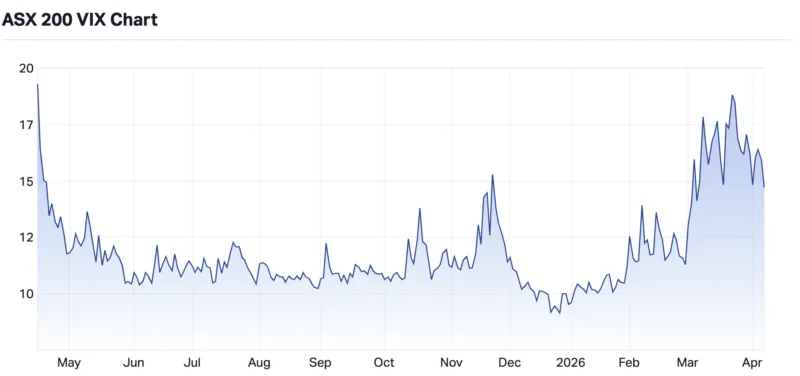
And it has sharply risen since the start of 2026 – up around 60% since the start of January.
When volatility and uncertainty are high, the level that share prices can rise and fall can be significant. For many investors, especially new investors, this can be an uncomfortable environment as nobody likes to see an investment fall 5%, 10% maybe even more in a single day.
The price of admission
A common saying is that volatility is risk. But volatility is normal. If there were zero volatility, prices simply wouldn’t change. Sure, you wouldn’t lose money, but you wouldn’t make money either.
Another way to look at it is that volatility is simply the price of admission. A ticket into one of the most powerful wealth mechanisms in the world – the share market.
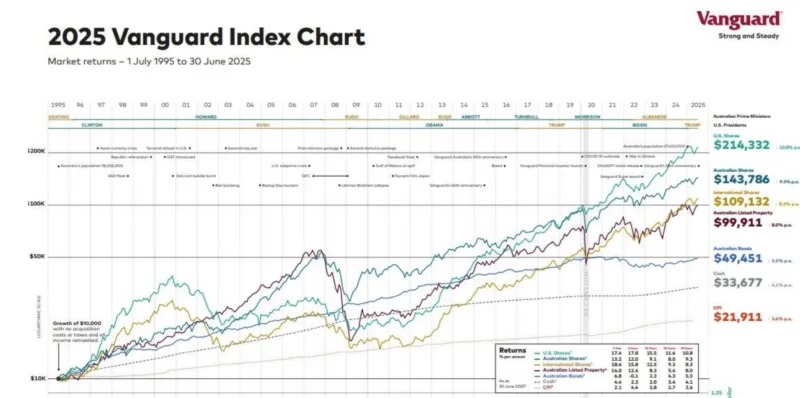
Source: Vanguard
According to Vanguard, $10,000 invested in the Australian market in 1995 would have turned into just under $144,000. During this time, there were multiple elections, technological disruptions, wars, economic shocks, share market crashes, global emergencies and natural disasters.
And every time one of those scary things hit, whenever “uncertainty” and “volatility” appeared in the market, many investors jumped ship, waiting for calmer waters, selling out. As history shows, they would have been better off staying invested or investing more.
Much ado about nothing
There will always be a new reason to talk yourself out of investing.
Today’s news cycle is built around sensation, fear and shock. But the best investors keep calm and invest anyway, regardless of today’s headlines.
Just look at the last couple of weeks on the market.
The war in Iran has spooked not just share markets but commodity and other financial markets as well as the closure of the Strait of Hormuz on Iran’s southern coast has closed the artery that supplies around 25% of the global seaborne oil supply, as well as significant deliveries of LNG and fertiliser.
Last week, investors were pessimistic, fearing global economic disruption. This week, investors are optimistic as the White House talks cease-fires and the reopening of the Strait and, therefore, oil supply.
Next week, nobody knows what will happen.
Whatever does happen, in ten years, today’s volatility won’t stand out, but the choice of whether to stay invested or even invest more will.
And the decision to exit investments today because of fear will likely stand out even more.