

I’ve been thinking a lot about power laws.
Not the academic version.
The real-world version. Like this…
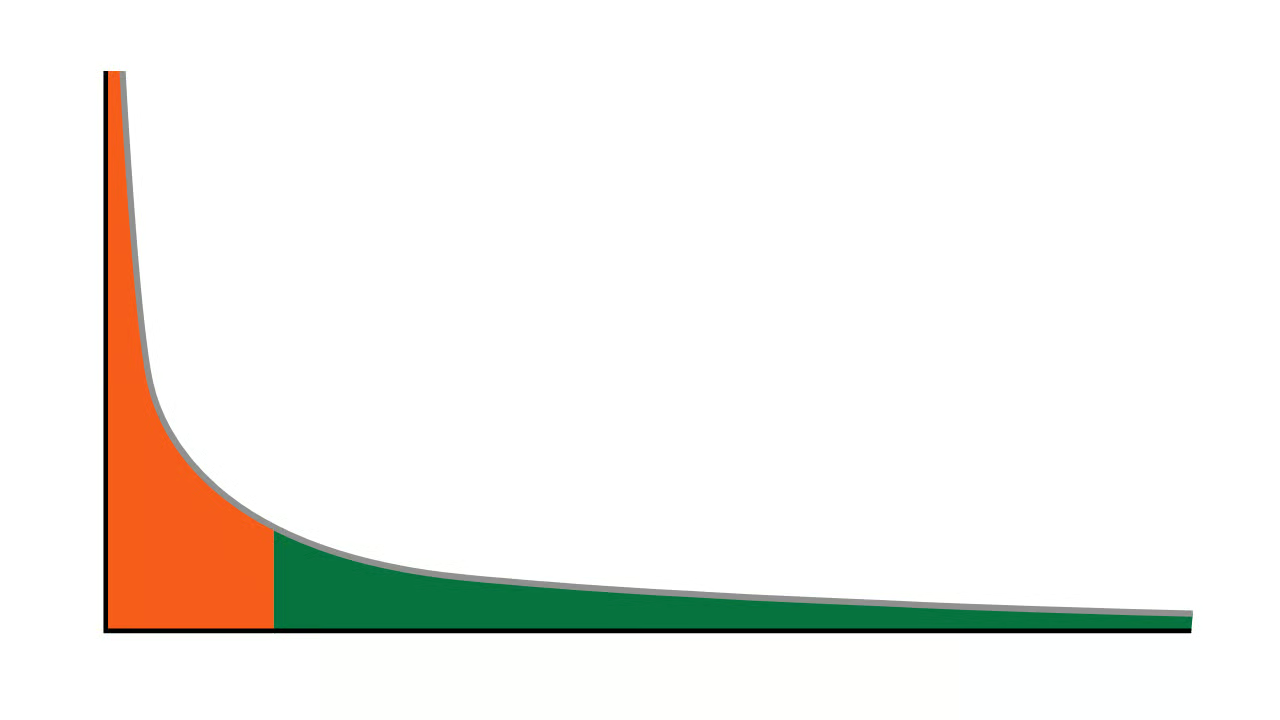
The version where a tiny number of companies, people, ideas and technologies capture most of the value. Investing has always worked this way.
A small number of shares drive most of the long-term returns in the share market. For example, as I wrote to you years ago, as few as 1-in-72 stocks do better than boring Government bonds.
It also applies to families or founders. A small number of families can build a lot of the world’s economic value. Elon Musk sold his stake in PayPal for $175 million, then grew two $1 trillion+ companies (SpaceX and Tesla) and who knows what Neuralink will be capable of.
And for all of us, a small number of decisions shape most of our financial life. For example, my decision *not* to buy a beat-up property in outer Melbourne in 2013/2014 cost me more than $1.2 million by age 33.
Ben Graham (Warren Buffett’s mentor, considered the father of value investing) made more money from one stock (GEICO, 572x his money) than all other stocks in his career.
AI is like this, except potentially even more extreme. Because AI is not just another power law: I think it’s a power law sitting on top of another power law.
And it’s happening faster than anything I’ve ever seen. Think about this.
OpenAI launched ChatGPT in late 2022. Within a year, OpenAI said it had reached US$1 billion of revenue (Facebook took 6 years). By the end of 2024, it was doing US$1 billion per quarter. OpenAI has since said it is generating around US$2 billion of revenue per month.
That’s ridiculous.
Not “cool technology company” ridiculous. Not “fast-growing software company” ridiculous. I mean historically, it’s ridiculously fast.
Then there’s Anthropic, the company behind Claude. Claude was basically a curiosity for most people not long ago. It didn’t earn *any* revenue until March 2023.
At the start of 2026, it was doing $9 billion of annualised revenue. Now (just a few months later) reports suggest it could be heading towards a US$50 billion annualised revenue run-rate by end of next month!
For another twist on the value creation: it’s estimated we could see the world’s first $1 billion per year solopreneur company this year. $1 billion. 1 employee.
(We’ve already got dozens of companies/individuals doing $1m per month… but $1b per year is 83x that).
Again, this is not normal. At least, I’ve never come across it.
This is not how companies used to grow. It took decades for some of the world’s most important businesses to reach this scale, and these AI companies are doing it in years. Sometimes months.
And then there’s xAI, the company behind Grok. I’ve been flapping my gums about xAI and Google’s Gemini being ‘underdogs’ for over 12 months.
Depending on which part of Elon Musk’s empire you look at, many reported valuations are now being measured in the trillions.
Meta (the suspect new name for Facebook) reportedly offered extreme compensation packages to lure elite AI researchers – up to $1 billion per year!
But here’s the rub: it’s not because they’re generous.
It’s because the potential value being created by, maybe, 50 people, globally, is so enormous that one person, one team, one model, one breakthrough or one distribution advantage could be worth hundreds of billions in a very short period of time.
That’s the world we’re in. And I don’t think most investors or business owners have fully processed it yet.
(The other half are getting sick of me saying it.)
Most people are still trying to work out whether AI is useful. Some are denying its existence.
Meanwhile, the companies building it are trying to work out how to scale it fast enough.
On Friday, I discovered research that shows we need to 10x the number of batteries in existence – just to keep up with orders from AI data centres and electric vehicles over the next 5-10 years. Current orders already exceed the world’s known energy storage systems (ESS)… every year.
I think that gap matters. A lot. So here’s how I’m thinking about it.
Traditional software is powerful. But you had to learn it.
The average person can barely connect a printer, which meant people who could code were easily capable of earning $300k+ in salaries, pre ChatGPT.
This meant it was hard to unlock technology’s potential because you lacked developer resources. You also had to install it. You had to train staff. You had to change workflows. You had to convince people to use it. Then you were often left with ‘code debt’ (outdated code and software).
AI is different.
On the surface, it looks like a chatbot (with a little too much giddy optimism: “I’ve found the root cause!” “You’re so right!” “That’s it!” “I’m absolutely sure this time.”).
But seriously. The ease of use matters.
For a decade, accountants could use MYOB to do a tax return: it just gave users chronic constipation because it was so stressful. Then Xero came along and said “we do beautiful accounting software”.
Instant relief. Massive adoption.
To go parabolic, users need intuitive tools. And the AI chatbot interface is basically instant.
You don’t need to learn a complicated menu.
You don’t need a 200-page instruction manual.
Or how-to docs.
You type. Or speak. Then listen.
It responds with something magically powerful. I know this sounds simple. But simple interfaces change the world.
The iPhone versus Android.
Google Search versus Bing.
Airbnb v real estate websites.
The best consumer apps are simple. And AI might be the simplest interface we’ve ever had – for arguably the most complex technology we’ve delivered.
That is one power law.
But then you add distribution. AI is delivered through the internet.
No stores (RIP, Blockbuster).
No physical product (Amazon who?).
No waiting for a CD-ROM in the mail (Cya, Netflix).
A person in Melbourne, Mumbai, Munich or Miami can use the same tool within seconds (side note: this is why Claude has gotten so slow over the past 2 months – too many people are trying to use the same data centres and it can’t keep up!).
Borderless business means you’ve basically got the entire planet instantly funnelling their knowledge, workflow and dad jokes straight to a server farm in middle America via undersea fibre optic cable. If you wait more than 5 seconds for a response, you’re annoyed.
Huge TAM (total addressable market) ✅
Virtually no distribution cost ✅
Instant distribution is the second power law.
Then you add cloud computing.
Once this infrastructure exists, these tools can scale globally.
Yes, compute is the bottleneck right now (it’s estimated as many as 50% of Australian electricians will work on data centres alone).
Yes, data centres are expensive.
Yes, the energy demand is insane.
But the direction is clear:
- More chips
- More data centres
- More models
- More applications
- More users
Then you add abstraction.
For those of you who haven’t heard of abstraction – this medium post, or the image below, explains how technology works.
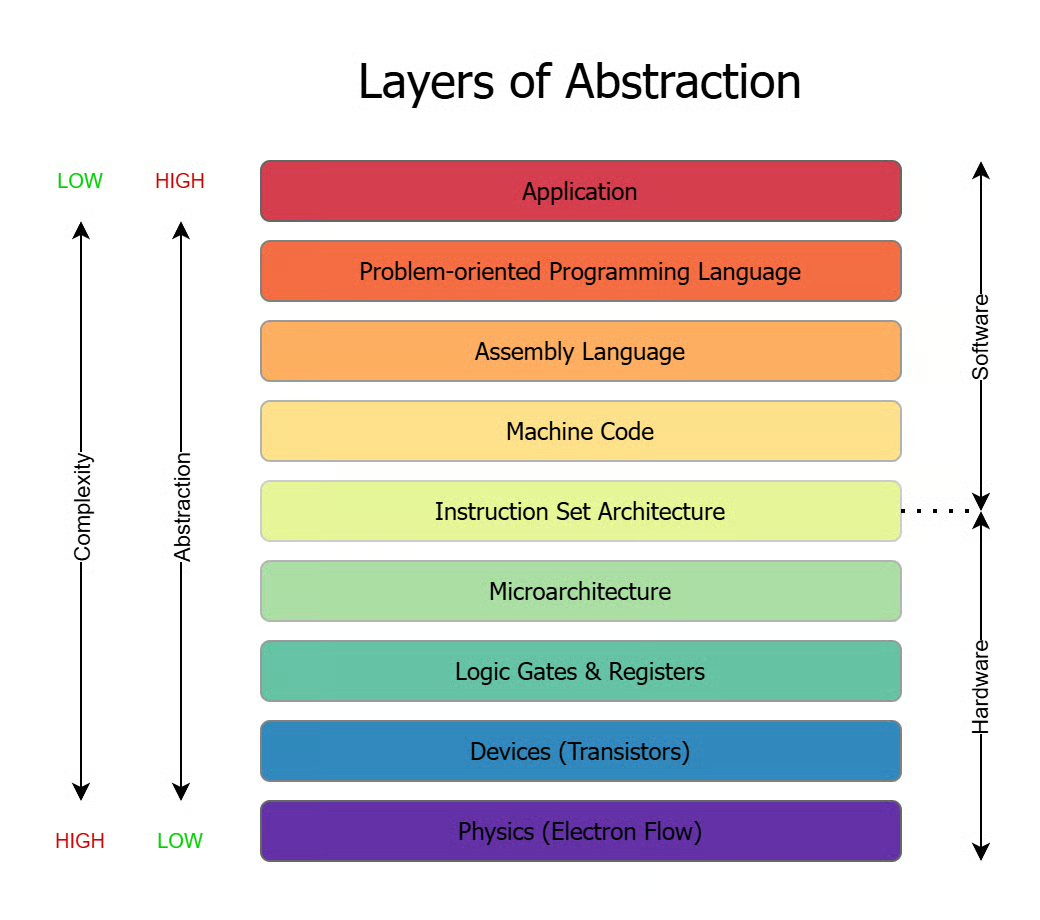
This is the part of technology I think most people miss.
But it’s something I began studying in 2011 as I immersed myself in anything that would explain why Microsoft chose not to make computers (it makes the software) and why Facebook was rumoured to be the most profitable company in human history.
AI doesn’t just help you do one thing faster (people who think AI is about speed should remind themselves that they can’t make a baby in one month by getting 9 women pregnant).
AI puts all layers of technology into overdrive and simultaneously expands your impact radius:
- A designer can now code.
- An analyst can write.
- A salesperson can create marketing campaigns.
- A graduate can interpret a corporation’s quarterly results.
- A chippy can create CAD visualisations for a client’s renovation.
- A small business owner can now access capabilities that once required a team of specialists.
- A small company can now look like a large company in customer support.
That’s why this is so powerful. AI compresses the distance between idea and execution.
And, obviously, that has implications for investors.
It has implications for business owners.
It has implications for careers.
It has implications for how you live.
And, yes, it has implications for how wealth is created.
(For the record I DON’T think this means every AI company is a good investment. But I think the bigger mistake is pretending this is just another theme – like Blockchain, crypto, marijuana, or drones.)
For investors, the questions you want to be asking are these:
- Which companies get more valuable because AI exists?
- Which businesses lose pricing power because AI exists?
- Which software companies are being disrupted?
- Which software companies become more important?
- Which infrastructure companies benefit from the demand for compute, energy and data centres?
- Which listed companies are quietly becoming AI-first businesses?
- Which private companies are now worth far more than public market investors realise?
- Which industries are about to be repriced?
- Do smaller companies become more profitable compared to larger companies which simply use AI as a cost out (e.g. ANZ).
And perhaps most importantly: how do you build a system for identifying the AI winners?
That’s the investing side.
For business owners, the question is different. It’s not: “Should I use ChatGPT or Claude in my business?” That’s like asking in 2005 whether you should use the internet.
No sh!t, Sherlock.
For business owners, the better question is: Where does AI create the highest return on time, money and human attention inside my business?
Sales?
Marketing?
Customer service?
Research?
Operations?
Training?
Compliance?
Finance?
Product development?
Recruitment?
D) all of the above?
The answer will be different for every business. But the opportunity is real. And it’s immediate.
And finally, for individuals. For all of us reading this.
I think ‘the AI question’ is even more confronting: Do I want to be the person who waits? Or the person who learns and multiplies my impact?
There is a version of the future where AI feels scary. As you know, I estimated 5.5 million Australian jobs will be “impacted”. Some more than others. Many current skills will become less valuable. New skills will become more valuable.
I recently spoke with Figma’s Head of Insights (globally) about the story of a young man who had no qualifications but was “AI proficient” and brought a team of AI agents into a totally new industry. Unstoppable.
That dynamic can make people feel uncomfortable. I get it – I have nearly 20 team members at Rask and I care for every one of them. I’ll do anything to help them thrive.
But fear is a terrible strategy. Think of how many times you’ve been too scared to invest or thought about selling. Yet the stock market has risen higher and higher and higher… over 150+ years – despite world wars.
Curiosity is a much better reaction.
A practical step
Use all of the AI models and ask them what they can do for you.
Just this week, Grok integrated seamlessly with Gmail and Google Drive. It can read and respond to unanswered emails, slot something into your calendar with a booking link, and so on.
Codex did that a month ago.
Claude Cowork did it a few months ago.
OpenClaw did it last year.
In the US, ChatGPT can buy stuff from Etsy and have it delivered. Pretty neat, right?
The people who lean into this structural change with optimism, judgement and discipline are going to move faster.
On a Rask podcast, futurist Steve Sammartino called it so well in 2023, when he said, ‘some of us will be like chimps who decided to stand up and cross the Savannah’.
The best next step means understanding AI properly. Doing a YouTube course on deep learning (they’re free and amazing), or just a short course on computing to learn the basics.
This means knowing what AI can do.
And knowing what AI can’t do.
Doing so will give you so much confidence to embrace change and invest for the long haul.
That’s why I feel so excited about this moment in history.
Not because AI is magic. But because the combination of capital, technology, distribution and human ambition is creating something extraordinary.
It’s a power law on a power law. And those who can leverage it stand to benefit, many times over.
Onward & upward,
Chief Investment Officer, Rask Invest
P.S. if you registered for Rask Ultra you’ll have to excuse me because the Government’s Budget on Tuesday really threw off our plans to host our exclusive webinar… Australia freaked out over the hefty changes that seek to undermine business and investing in Australia – and I had to respond. Some people have already figured out how to join and have done so (ahead of our official launch on the 1st of June). I’ll email you this week and hope to see you in there.