
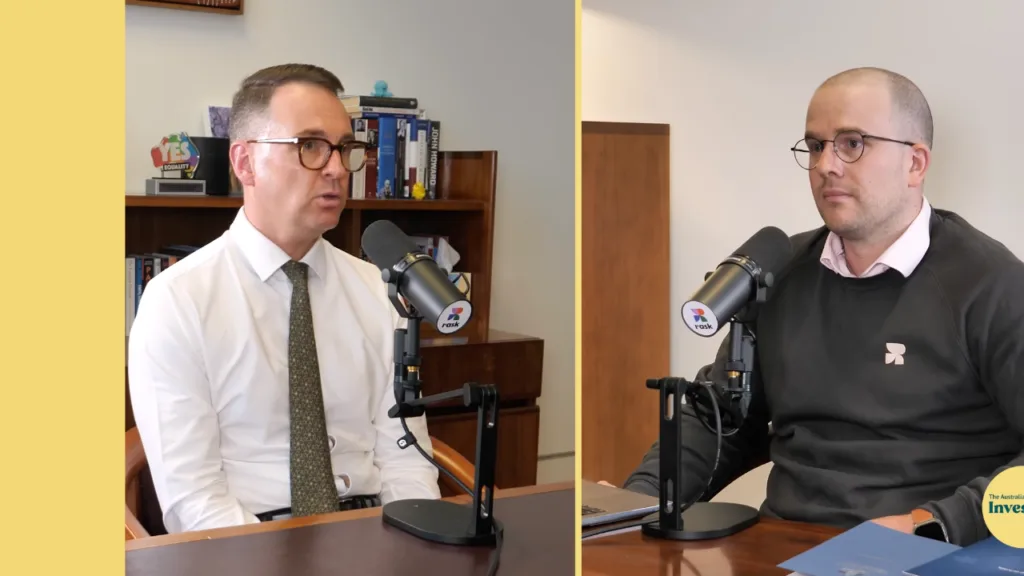
This week I went to Parliament House to interview Senator Andrew Bragg.
Andrew is a Liberal Senator who is considered more ‘central’ because he supported the Yes vote, Indigenous voice, climate targets and so on. His background is financial auditing, which makes him uniquely well placed to talk about a budget.
Broadly, his most important work is about simplifying the economic engine of Australia: fewer outdated laws, more entrepreneurial freedom.
We talked for over 60 minutes about housing, the 2026–27 Budget, the last 20 years of declining productivity (which I wrote to you about last week), taxes, housing supply and living standards.
This is all of the stuff that “sounds boring” until you can’t piece together why your life in Australia feels so expensive.
For years, I’ve kept coming back to one simple idea: Australia has a culture problem.
And we need to get serious.
Not in a political slogans kind of way.
In a basic economics kind of way:
- If we want cheaper housing, we need to build more homes. Which means fewer unions and ‘incentives’.
- If we want higher wages, we need higher productivity. Which means fewer laws and consumer protections.
- If we want lower inflation, we need to produce more of what people need. Which means generous handouts to businesses and research & development programs (i.e. people who take risk to build ‘the stuff’ and employ people).
- If we want clean energy, we need to import engineers and tradies. Not every Joe Blogs who simply wants to migrate here.
- If we want our privacy policies to actually work, we need to build data centres and AI in Australia.
- If we want better living standards, we can’t keep making it harder, slower and more expensive to do useful things. We need to cut laws, not make new ones – like the horrible 5% deposit scheme (which really should be called “the 95% loan scheme”).
These are the bits that get missed. And it’s all part of our culture towards work and business.
Housing is the easiest example for most of us to grasp.
Australia is meant to be building around 240,000 homes a year under the national target – this is what everyone agrees is the required minimum to make Australia affordable (everyone except the numpties at The Australia Institute would agree with this).
Realistically, with population growth and years of undersupply, the number probably needs to be even higher than that. Closer to 260,000 – 300,000 new houses per year.
But we’re not there.
Not even close.
Recent figures show Australia could be going backwards.
Since Anthony Albanese announced Labor’s target of 1.2 million houses (starting in 2024, finished by 2029) – implying 240,000 houses per year – we’ve actually built less.
ABS data for ‘starting houses’ says we’re on track for just under 200,000.
But completion rates are implying 170,000.
(Remember, I wrote to you a few months back detailing that building products are still rising, fast. In April, Reece increased its prices for pipes and plastics by ~30%.)
Even if we’re being generous, we’re 40,000 houses short (20% below baseline) and falling behind.
That gap matters.
Because a housing shortage is not solved by speeches.
It is solved by actual houses.
Actual homes.
The things people live in.
These include:
- Concrete.
- Timber.
- Trades.
- Land.
- Approvals.
- Finance.
- Roads.
- Sewers.
- Power.
- Investors (and/or banks).
- And, perhaps most importantly, time.
Every extra delay adds cost.
Every extra cost makes a project harder to stack up.
Every project that doesn’t stack up means fewer homes.
Fewer homes means higher rents.
Higher rents mean more pressure on wages.
Higher wages without productivity means rapid inflation.
More inflation means higher interest rates.
Higher interest rates make it harder to build.
And around and around we go.
That’s the vicious cycle we’re stuck in.
This is why productivity matters so much.
Productivity is not a spreadsheet.
- It is living standards.
- It is how much we can produce for each hour we work.
- If it goes up, wages can rise without prices exploding.
- If it falls, life gets harder.
If Australian culture (which is what I believe directs political change) continues on our trajectory, we will all:
- Have to work more.
- Pay more tax (especially in retirement).
- Pay more rent.
- Pay more interest.
- Rely on Government handouts.
- See more social unrest.
- And still feel like we’re going backwards.
That’s Australia’s problem.
For 20 years, our productivity has been sliding.
We have compensated by:
- Selling more of our minerals (iron ore, copper, gold, coal, etc.) and energy (oil & gas).
- Bringing in more people.
- Working more hours (side hustles, multiple jobs, etc.).
- Increasing tax.
Obviously, this can only go so far.
Eventually, the bill arrives.
When governments spend more than they can sustainably afford, they have four broad choices:
- They can borrow more. Australia’s Government debt is skyrocketing (and our household debt is immense!)
- They can cut spending. The Government has done the complete opposite of this (95% loan scheme, NDIS, Government-run housing institutions that have cost us tens of billions per year… for few houses, etc.).
- They can try force the RBA to print money. Known as Modern Monetary Theory (MMT) this practice will have terrible consequences if we can’t control spending.
- They can raise taxes. This seems to be enough to cover our interest – not principal (debt to GDP is increasing). And eventually it’ll drive capital and entrepreneurial away. This is what’s happening in countries around Europe and the UK. In case you’ve ever wondered “why doesn’t Europe produce as many world-leading companies as the USA, despite nearly twice the population?” Now, you know why.
Usually, Governments do a bit of all four tactics.
And please don’t take my word for any of this. Here’s the trajectory for Government debt – as per the official Budget papers.
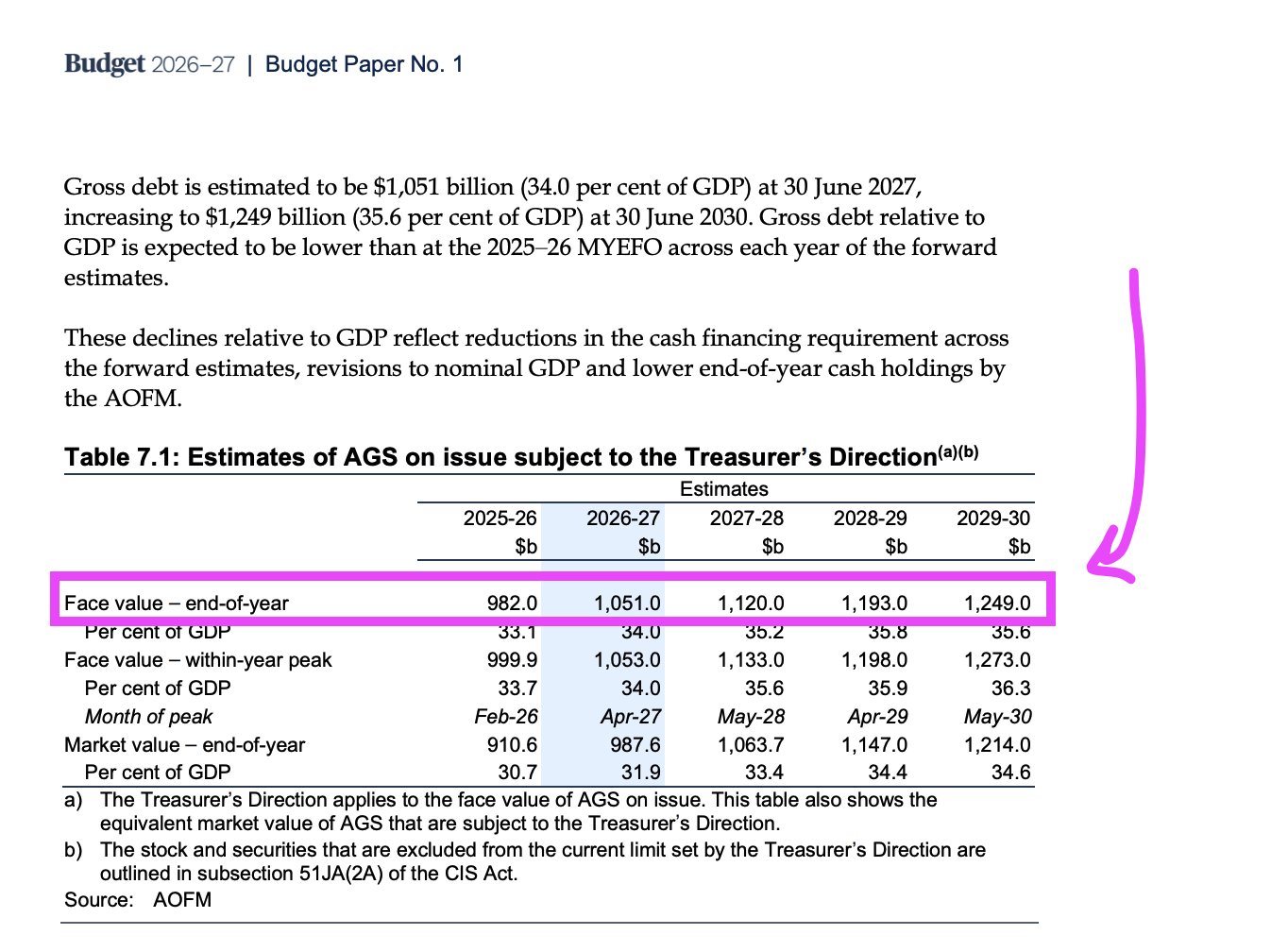
That’s a 27% increase in Government debt in the next four years…
Here’s how it stitches together:
If we keep idolising sport stars and actors more than entrepreneurs and ‘doers’, voting people into Canberra who have never worked a real job, adding laws to protect for the worst case scenario, or piling new taxes into the same economy that we are asking to build more homes and great businesses, we shouldn’t be surprised when the results are really bad.
You can’t tax and regulate your way into abundance. You have to build it.
This idea doesn’t mean “no government” (like the crazy Libertarians think can work).
It doesn’t mean no safety net (we need the NDIS, Medicare, public schools and hospitals, defence and bulk billing).
It doesn’t mean no tax. Of course we need tax.
But it does mean we need to be honest about trade-offs:
- If we want more homes, Government should make it easier to build homes. Labor’s plan to fund some infrastructure like sewers and roads – about $2 billion worth, which is small, but something – is a good start.
- If we want more investment, our Government should reward productive risk-taking. Not property speculation or chucking money into Super for tax breaks, but actual investment into companies, the stock market, small businesses and so on.
- If we want higher wages, Government should help businesses invest, innovate and grow – not laugh about taxing people ‘who don’t work for money’ (as per the Treasurer’s statements).
- If we want lower inflation, we need more supply, not just more subsidies.
- And if we want better living standards, productivity has to become more than a buzzword.
It has to become ‘the’ national project.
Because this is not really about politics. It’s about the future of Australia.
And it’s primary school math.
Australia can’t keep asking households to carry the cost of bad systems.
- Higher rents.
- Higher mortgage repayments.
- Higher taxes.
- Higher prices.
- Lower real wage growth.
- Higher fuel excise (when gas exports aren’t taxed!)
- Longer waits at the doctors or hospitals.
- More paperwork.
- More businesses failing.
That’s not prosperity. It’s the drift that comes from a culture taking things for granted.
But the good news is: we can fix it.
Australia has extraordinary advantages.
- Natural resources. We must tax resources just a little more – because we’re running out – and then push that money into a public investment fund. That fund, in turn, could support more infrastructure (e.g. rail or ports) for even more efficient resources (eg. critical minerals processing or lithium battery plants) for a stronger supply chain and higher revenue.
- A strong education system. We import amazing talent and foster homegrown excellence – the issue is we’re lose them to foreign employers. We have one of the worst tax environments for start ups in the world.
- A growing population. Before these new taxes, our millionaire migration was #2 in the world. That’s a positive because it should bring investment to Australia. But just because a person migrates here, it doesn’t mean they bring their money with them – if they feel like the Government will punish them (which they are), they’ll simply leave their money in the old country and enjoy our benefits instead.
- Deep capital markets. Our financial system – banks, individuals, Super – can support huge projects and want more opportunities (this why stocks on the ASX always trade at higher valuations compared to USA stock markets). The problem is, the regulation means far fewer companies will ever consider the ASX (see Canva, Atlassian and thousands of smaller companies). And the Government’s 30% tax on everything means there’s less incentive to invest in growth – people will be better off just focusing on dividends or interest.
- World-class entrepreneurs. Dollar for dollar, Australia’s start-ups are way more effective than Silicon Valley and the USA. Why? We don’t have enough funding, so we have to fight for every dollar.
- Technology. We can be proud of many things (as I said last week) but there’s still a lot to do. We just need to foster a culture of winning, not tall poppy syndrome.
- AI. We were about to build an unbelievable number of AI data centres and related technology. The rise of AI could make our companies more competitive globally.
- Energy. It’s absolutely crazy to me the Government left us with just 30 days of fuel and we had to negotiate with South Korea, Japan and China for our own fuel and gas (which are the same countries who benefit most from us not taxing our offshore gas exporters). Hence why the Prime Minister was reading straight from the gas lobby “research” in Parliament a few weeks ago… then was caught red faced. This is the prime example of taking pride in Australia – and not simply trying to win the next election.
- Agriculture. Our farming and technology is top tier, globally. We have so much potential for leading the world through farming technology and efficiency.
These sectors can all support the future Australians want. But they are HARD to do.
- We have to put Australia first.
- We have to take pride in our country.
- We have to plan for at least 10 years into the future and make the research public (China has a 100-year plan, the White House under Trump has numerous multi-year plans).
- We have to build.
- We have to innovate.
- We have to let good ideas move faster.
- We have to make housing easier to supply (we should be focusing on way more important things).
- We have to stop receiving handouts.
- And stop treating productivity as someone else’s problem.
Those were my biggest takeaways from my time in Canberra.
Australians don’t need to be negative (like people from the UK always seem to be).
But we do need to be honest with each other.
Living standards don’t magically rise.
They are built.
One productive decision at a time. Listen to the podcast.