

We’ve seen hundreds of financial planning clients. Hundreds of thousands of people have listened to our podcasts. Around 40,000 have enrolled in our free finance courses. So we’ve seen a lot of retirement mistakes across Australia. Here are 6 of the worst retirement mistakes we’re seeing in 2026.
On 21 September 2026, the Government released its 2026 Intergenerational Report.
Over 300 pages of data, facts and figures from the same department that validated the Government’s recent tax increases revealed a few things.
Treasurer Jim Chalmers himself called the data “confronting”.
Rather than recite the key learnings, I think the impacts are most profound for retirees. Let me explain…
Buried amongst the hundreds of assumptions, 40-year forecasts and government-speak was one sentence worth paying attention to:
“We cannot be complacent.”
I agree.
Not because Australia is doomed.
Unsurprisingly, Treasury actually expects Australians to be wealthier in 40 years.
However, the path there will look VERY different from the one that created wealth for the previous generations.
Treasury itself identifies five enormous transitions already underway:
AI.
Geopolitical fragmentation.
The energy transition.
An ageing population.
And a changing industrial base.
In other words:
The world is changing.
Our economy is changing.
The tax system has to change.
So the Super system is smack-bang in the crosshairs – of all three potential Governments.
Property is under severe pressure. As we know.
But inflation and interest rates are still expected to be higher by Christmas.
Ouch.
Ultimately, I think this all means the assumptions underneath your retirement plan need to change.
Here are 6 financial assumptions and risks I wouldn’t be comfortable making anymore.
In short: The six mistakes are putting off retirement planning, relying on property alone, carrying too much debt, assuming tax rules won’t change, counting on historical ASX returns, and letting overwhelm stop you from acting.
1. “I’ll sort out retirement when I’m 60.”
This is the biggest one I’m seeing every day.
Now that times have gotten tough, people are burying their heads in the sand and saying things like “well, I’ve got this far“.
People often start seriously thinking about retirement precisely when their greatest wealth-building asset is disappearing: their salary.
At 35, you have another 30 years of earnings ahead of you. You’ll make it up.
At 58, you don’t.
It means fewer years to compound investments, fewer years to reduce debt, fewer years to fix a bad super strategy and fewer years to recover from mistakes.
You don’t need a 47-page retirement plan at 32.
But you should have some idea where you’re going because TIME is the only financial asset you cannot buy back. At least, last time I checked.
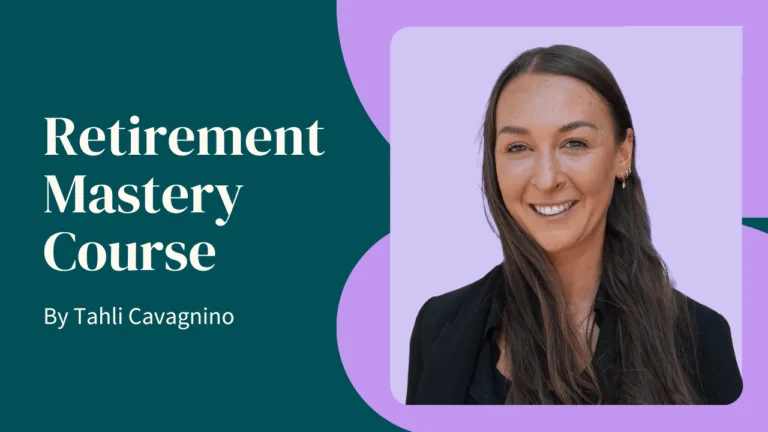
Our free retirement academy program by Rask’s Co-Head of Advice Tahli Cavagnino costs literally nothing. Please don’t bury your head in the sand.
2. “Property will keep doing what property has done.”
Australian property has created staggering wealth. The ripple effects of it are going to be severe.
For decades, the formula has been pretty simple:
Buy house.
Borrow money.
Negative gear.
Wait.
Price go up.
Repeat.
But “my house is worth a lot” is now coming undone. It isn’t a retirement income strategy. Especially now. Especially with the political heat.
You can’t buy groceries with the spare bedroom.
And even with the recent falls, properties are still a really, really poor-yielding assets. That’s before we consider inflation (3 – 4%) and maintenance costs (2-5%)… and interest rates (~6%).
Eventually, retirement requires cash flow.
Where does it come from?
Super?
Shares?
Rent?
A business?
Selling property?
Government benefits?
Probably some combination.
Property can absolutely be part of the answer. But it’s not ‘the’ answer.
Relying on ever-higher property prices, ever-more debt amongst Aussies and today’s tax settings continuing indefinitely feels like a much bigger bet to me.
Years ago, a famous IRS report showed that the average US millionaire had 7 sources of income.
I think that’s what Australians should be thinking about. It’s where we’re heading.
My challenge to you: can you pull together good (tax-free) income from Super, a few grand a month from part-time work, some dividends and/or rental income? That’s a resilient income playbook I can rally behind. Especially when you correctly factor in the usual sequencing and tax policy changes.
3. “Debt is fine because my assets are going up.”
Debt feels brilliant when the asset on the other side keeps rising.
The problem is that debt doesn’t care if markets fall.
It doesn’t care if you lose your job.
It doesn’t care if you’re sick.
And it definitely doesn’t care that you’d rather retire at 60.
Australia remains a highly indebted household economy, which the RBA continues to identify as an important vulnerability, even though many households have remained financially resilient so far.
In Australia we talk about property as if it’s a first-home buyer problem. It’s not.
It has knock-on impacts.
Over the next 10 years, I’m predicting a record number of retirees will still have a large mortgage.
The question is not:
“Is debt bad?”
It is:
“What does my financial life look like if things don’t go perfectly? Especially in retirement.”
What if rates rise?
Rental income falls?
Costs go up?
Property goes sideways for five years?
Your passive income shouldn’t be contingent on one thing happening, all of the time. That’s poor diversification, especially without an active income (your salary) it’s less forgiving. Ask yourself honestly – does it make more sense to nail the debt, then retire? Or downsize now, to boost Super and your ETF portfolio?
4. “The tax rules will sort themselves out.”
Here’s a financial planning assumption I’m willing to make:
The tax system in 2046 will not be identical to the tax system in 2026.
(I know, bold – right?)
Super rules change.
Trust rules change (sometimes twice within two months!).
Property rules change. Obviously.
Contribution limits change.
Governments change.
Treasury’s own report says pressure on working-age Australians is increasing and explicitly discusses reforms to rebalance the tax system and strengthen superannuation.
That’s handy for a Government that’s trying to find any excuse to merge Super with Centrelink and ‘redistribute’ income to “working Australians”.
(They’re not even shying away from it: they called their $4 per week tax offset the “Working Australians Tax Offset”! Uh-oh…)
So, please, don’t build your strategy on something that only works because of one tax concession.
Negative gearing? Gone!
A generous Super pot? Taxed!
If you’ve got a company, family trust, SMSF, investment properties and a large super balance, understanding how those structures interact is becoming more important, not less. James Phelan, our other Co-Head of Advice, told us how to wrangle these complex situations at our live event in Melbourne.
Good financial plan ask:
“What happens if the rules change?” Or, “should I be doing something… now?” Being prepared for uncertainty always brings me the confidence to act – to seize opportunity or duck for cover.
5. “The ASX 200 will give me 10%.”
This one is going to annoy someone. But it’s my pet peeve. I’ve been writing about it for 5-10 years.
And, for the record – I love index funds.
But an index fund (or index ETF) isn’t the magical compounding machine you’ve become accustomed to.
Ultimately, share prices need something underneath them.
Earnings.
Dividends.
(Side note: earnings is the US word for “profit”.)
Finally, they need the valuation that investors are willing to place on those earnings.
While share prices can fluctuate, the reason the share market goes up is because companies get more profits over time. From 1900 to 2025, profits for Australian companies have shot the lights out.
I calculated that yearly profits for US companies rose about 6.7% during that time. Even faster recently, thanks to the internet and AI companies.
But here’s the rub: Australian profit growth is expected to be just 2.6% this year.
Think about that for a second.
While share prices go up and down in the short term (profits and share prices do not move in lockstep every day, week, month or year)…
If the businesses within the stock market aren’t growing profits very quickly, where exactly are decades of fantastic returns supposed to come from?
Maybe profits accelerate. Unlikely with huge politician-led innovation in our country.
Maybe commodity prices keep booming. They’ve already boomed…
Maybe valuations expand. They’re already near records…
Maybe innovation creates enormous new winners… “with these tax increases?”
Nobody knows. But it doesn’t seem… likely.
And that’s precisely my point.
I wouldn’t take the fantastic historical returns from Australian property, Australian shares or US technology stocks, plug them into a spreadsheet for another 30 years and call that a retirement plan.
I’d call it a risk.
Diversification matters.
Valuation matters.
And increasingly, WHAT you own matters. Please do not bet on one thing, in one tax structure or in one geography.
6. “This is all too hard. I’ll deal with it later.”
This is the sneaky one that’s very common. It’s called overwhelm.
Doing nothing FEELS like avoiding a decision.
But, at retirement, it isn’t.
Leaving $800,000 sitting in an inappropriate super option is the decision.
Keeping three investment properties because they’ve always gone up is the decision.
Holding too much cash for ten years is the decision.
Never reviewing your insurance is the decision.
Retiring first and figuring out the tax strategy afterwards is definitely the decision.
You don’t need to predict the future. In fact, don’t.
You need to prepare for more than one future.
That’s different.
And that’s probably my biggest takeaway from the Intergenerational Report.
Treasury isn’t saying Australia is stuffed… yet.
It’s saying enormous transitions are underway, and Australia’s outcomes depend heavily on our politicians, productivity, investment, culture change, innovation and more babies! (Our birth rate is on track to fall to a record low of less than 1.4 babies per woman – when the sustainable rate is 2.1).
Treasury is assuming long-term labour productivity growth of 1.2% a year — and says achieving it will depend on innovation, skills, investment and reform. But if you ask me – with AI and entrepreneurs keeping their businesses in Australia, we’ll be lucky to get half of that.
Letting Chinese companies binge on our resources until 2007 worked.
Gearing up a property portfolio until 2025 worked.
But times are changing.
But remember, there are only a few things you can control:
You can’t control geopolitics.
You can’t control the tax system.
You can’t control markets.
But you can control how much you save.
How much debt you carry.
How diversified you are.
How your super is structured.
How much you invest outside Super.
How much risk you take.
When you retire.
And whether you actually have a plan.
If you ever want to book a free financial planning discovery call with me (I’ll try to help even if we’re not the right fit), you can do that here (it’s free). Otherwise, try the latest episode of The Australian Retirement Podcast.