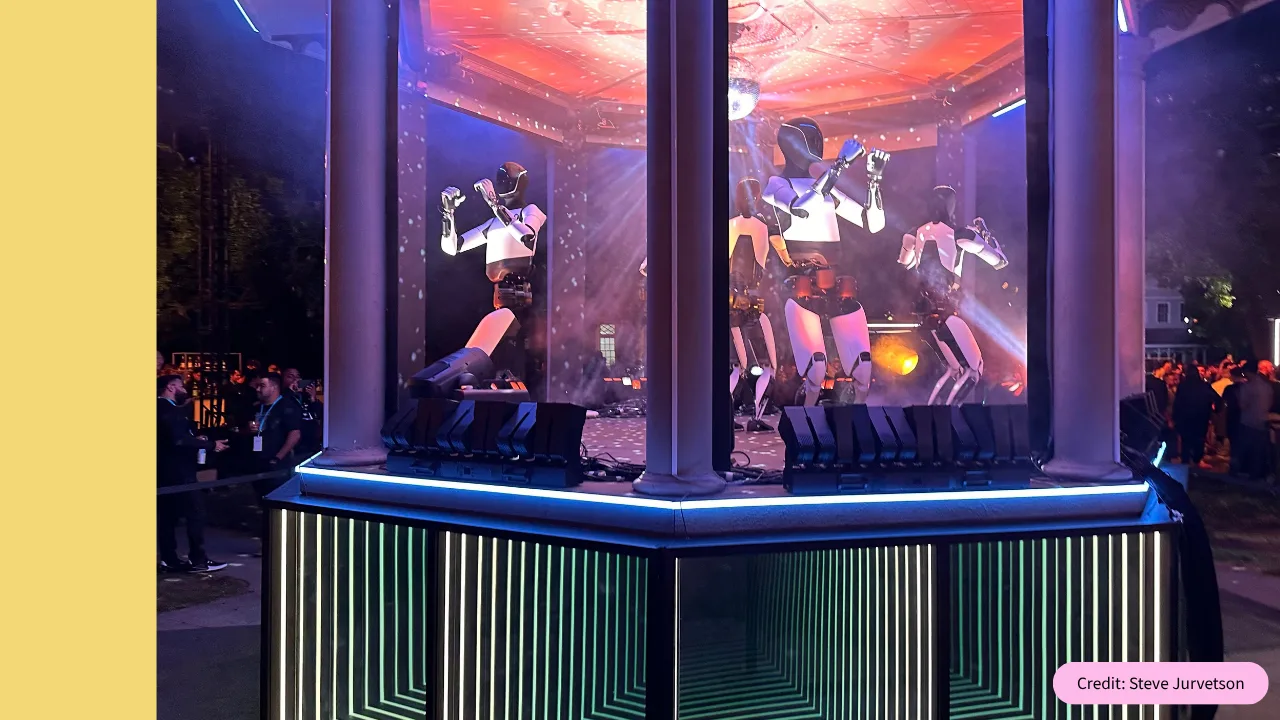

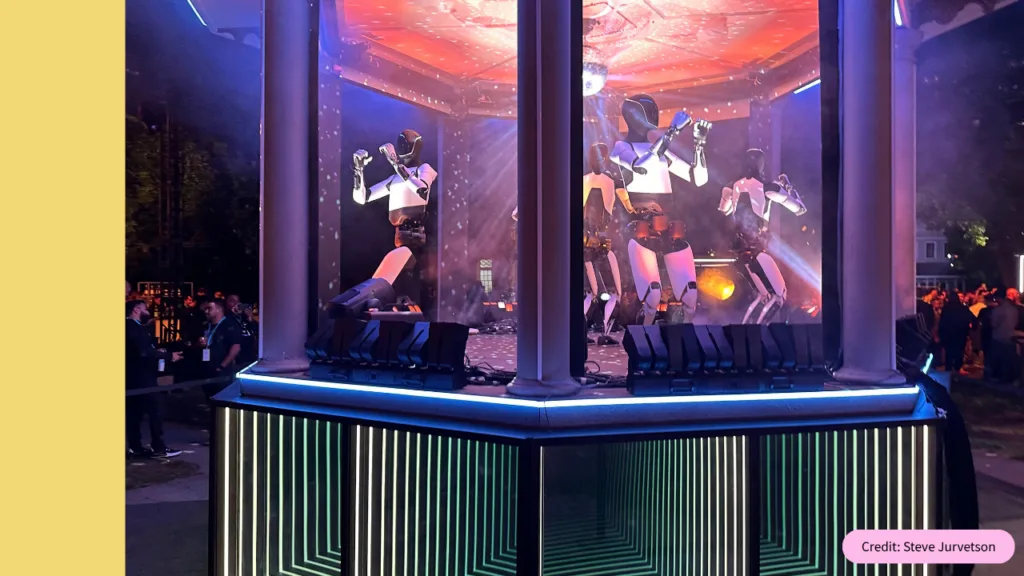
I just had one of those “oh wow, this is actually happening” moments.
On this weekend’s Australian Investors Podcast, Drew and I spoke about Tesla’s latest Full Self-Driving software.
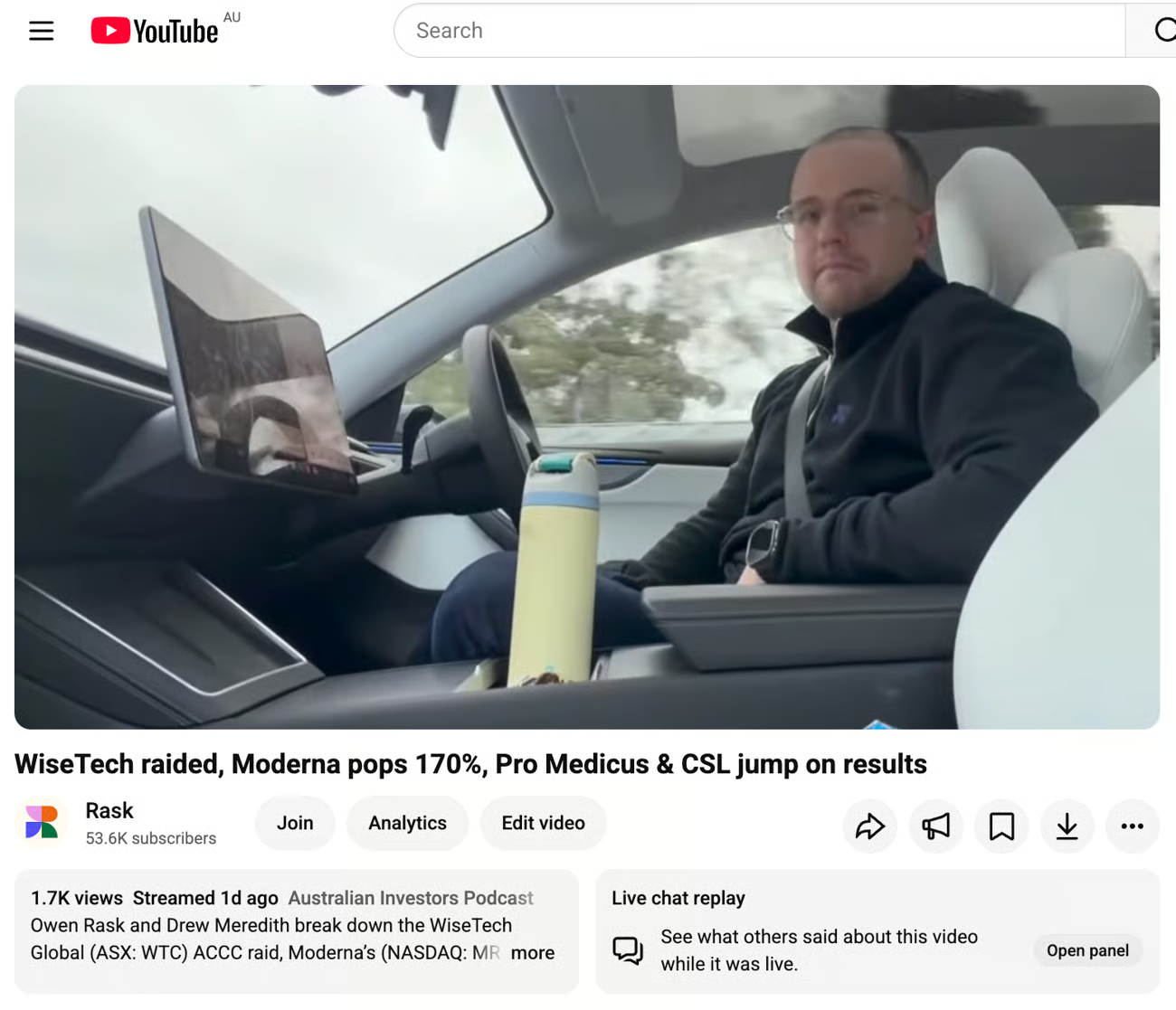
White, bald, nerdy, human male drives electric vehicle in podcast pre-recording. Source: Author supplied.
Now, before anyone emails me, yes, it is still supervised. Kinda.
You are still responsible. I think.
You still need to pay attention. They say.
But the actual reality of it is hard to ignore. I barely even check it… during 60 minutes of city driving.
Because the car drove itself out of my driveway, through traffic, into the city, up a multi-level car park and into a parking spot.
And the weirdest part?
It was probably better at it than me.
That’s when it hit me: robotics is no longer a far-off, “maybe one day” idea.
It’s beginning.
Not in the form of shiny humanoids politely folding our washing and handing us a cup of tea. Not yet, anyway.
But in the form of software that can see, react, move, learn and improve in the physical world.
That’s the big shift.
For years now, AI has lived on screens. It writes text, generates images, summarises documents and answers questions. Most people think this is all it can do.
Is that useful? Yes.
But robotics takes AI out of the laptop and gives it wheels, arms, sensors and responsibilities.
That is a much bigger deal. I’d guess this market is 50-100x the size.
Just think about what this could mean in practical terms…
For individuals, humanoids could mean safer roads, easier transport for older Australians, more independence for people with disabilities, help around the home, better healthcare support and less time wasted on dull, repetitive jobs.
How will the robotic rollout look in practice?
Tesla has already started releasing its Cybercabs – cars without a steering wheel or pedals – for staff-use only in Austin, Texas. Robotaxis (driverless taxis) and Waymos have been in operation for some time. So 100% robotic drivers are already amongst us.
For businesses, humanoids could mean lower costs, faster logistics, safer warehouses, more productive factories, 24/7 operations and the ability to keep growing even when labour is hard to find. Robots don’t need breaks, nor will they file a four-year Workcover claim if something is over 20kg.
For society, robots will mean fewer road accidents, stronger supply chains, better aged care, stronger defence capabilities without risking human life, much more local manufacturing and more human time redirected into judgement, creativity, relationships and caring.
That’s the dream, anyway.
The important question for investors is: who’s winning?
My view is that the winners won’t only be the companies with the slickest robot demo videos. China’s ‘World Robot Conference’ isn’t necessarily where we’ll find them either. But it’s a good start.
The winners will be the companies with the best combination of data, distribution, compute, manufacturing, customer relationships and real-world feedback loops.
Tesla (NASDAQ: TSLA) is interesting because its cars are already robots on wheels. But it’s nuanced. Every kilometre driven, every intervention and every software update can feed the machine – but it’s what you do with that data which counts.
I couldn’t believe it when I studied it but Tesla’s self-driving software is just 3,000 lines of computer code – which would be far less than this email takes to render on a phone. Almost every other car company has 100,000,000+ lines of code. Why? Because they haven’t got a neural network (basically, an advanced AI brain in every car). Now Tesla is taking that into humanoids – human-shaped robots.
Waymo, owned by Alphabet (NASDAQ: GOOG), is interesting because it has turned autonomous driving from a science project into a real service in US cities. Waymos are already available in major cities throughout the USA. However, its efforts are still largely focused on using data and advanced computing in driving. Tesla seems more ambitious in that regard.
Amazon is interesting because it already has one of the largest real-world robotics fleets on the planet, working inside its fulfilment centres. It also has its own chips and huge amounts of data backed up by a global cloud platform that leads in things like logistics. These robots seem mostly factory-bound, moving and packing.
NVIDIA is interesting because it provides much of the compute, simulation and software infrastructure that lets robotics companies train their systems before releasing them into the real world.
It’s really important to understand that AI and robots are just pattern-matching. They need an unbelievable amount of data to look ‘normal’ in their behaviour. This is why folding washing and putting it away is probably harder for a robot than driving a car. After all, how many people record themselves folding washing and then study their performance and improve it?
What investors are now figuring out is that NVIDIA may not be the only player in the game of GPUs (advanced graphics cards – the things that allow us all to create ‘seemingly real’ AI systems).
As Google/Alphabet and Amazon enter the marketplace with their own chips and data centres, NVIDIA’s position at the core of AI and robotics may be challenged. Still, I think NVIDIA is certainly one company that’s pivotal to a robotics future.
Then you have industrial robotics leaders, sensor companies, warehouse automation businesses, chip designers, software platforms and, increasingly, Chinese robotics manufacturers pushing hard on cost and speed.
This should not be underestimated. Even if the US dominates the consumer products, the reality is they may still be 100% dependent on China’s supply chains and manufacturing. That’s why Donald Trump is doing everything he can to support Elon Musk at Tesla and SpaceX; Jensen Huang at NVIDIA; IBM; Google and so on. If the USA can get 100,000 robots folding people’s washing, they may be able to fight off China’s deep robotic supply lines and continue to lead the world in technology, defence and economics.
I think the most interesting consumer-level robotics company from China is Unitree, which is owned by Yushu Technology. This is a Chinese A-share company, meaning its stock isn’t really available to investors outside of China… yet. Remember, as we’ve spoken about before, China protects its companies by allowing them to ‘win in China’ first (and list on the A-market) and only after they’re confident they can win on a global stage (like BYD, the car maker) do they allow outside investors.
Yushu is the company which has the fancy dancing robots that took the world by storm during Chinese New Year celebrations. It had a record-breaking IPO – raising over one billion dollars from investors – just four days ago. The company is now worth around $56 billion.
A market of robot stocks
In other words: robotics is not one stock.
It is an ecosystem.
That matters because we need to separate the technology from the investment outcome.
A robot can be mind-blowing and still be a bad investment if the valuation is silly, the margins are poor, or the competition becomes brutal.
This is where investors need to be optimistic, but not gullible. There’s an idea. Then there’s an actual business.
My base case is that robots first become common in controlled environments: factories, warehouses, mines, ports, farms, hospitals and delivery networks. It’s already happening. If you have seen the latest season of Clarkson’s Farm you’ll know what I mean.
This is here. And now.
But many of the robots we see are not truly probabilistic (i.e. a lot of the current robots don’t use “thinking mode” like an AI would; they use algorithms like ‘if this, then that’, which limit their potential).
Next we are moving further into transport. It’s early days but traction is picking up, fast. My guess is we’re probably less than 1% adoption in Australia thus far.
(Remember: ELECTRIC CAR DOES NOT EQUAL SELF DRIVING! People think Teslas are the same as Kia or BYD because they’re both electric. That’s dumb. There’s no competitive advantage in batteries.)
Eventually, probably in the next 2-6 years, homes will adopt robotics in a huge way.
This adoption will move quicker than cars because people see it as a lower risk.
We’re probably not at 0.001% yet, because people can’t physically get the robots delivered. Trust me, I’ve tried. I’ve had to dust off my Google Translate app because I’ve tried importing a humanoid from Mainland China…
Humanoid robots walking around suburban streets and cleaning up your kitchen will probably take longer than the viral videos suggest. But experiments are already underway globally.
In short, I’d be careful betting against the direction of travel. Like all change, this one is inevitable. And its economic impact will be enormously positive if Australia, and us as individual investors, are on the right side of it.
They may look awkward.
They may look silly.
They may look like gimmicks.
But one day, they will work. For us.
The mobile phone looked ridiculous once. Online shopping seemed strange.
Streaming sounded unnecessary. Electric vehicles were toys. AI was a parlour trick.
Then, slowly, then suddenly, they became normal.
I think robotics could follow a similar path. But its legacy will be far more profound.
The early versions will be clunky. Some companies will burn billions. Some investors will lose money. Some robots will fall over on stage and become memes.
Humanoids are probably still measured in the tens of thousands globally, not millions.
But the forecasts are wild: Goldman Sachs expects annual humanoid shipments to reach around 1.4 million by 2035, while Morgan Stanley sees a world with more than 1 billion humanoid robots in use by 2050. I think it may come even quicker.
But even if those numbers are wrong by a lot, the direction of travel is hard to ignore.
The software is done.
AI is learning to move through the physical world.
And when software learns to move, carry, drive, lift, build, deliver, clean, inspect and care, the economic opportunity becomes enormous.
I wouldn’t bet against innovation when the carrot dangling in front of it is the biggest opportunity this world has ever seen.
What investors can do now
For investors, this doesn’t mean rushing out and buying every robotics stock with a slick demo video.
It means paying attention.
It means asking which companies have durable advantages.
It means looking for real-world adoption, not just theatre.
It means knowing who is setting the standard, and how governments are supporting them.
It means understanding that the biggest winners may be the boring suppliers, platforms and infrastructure companies that sit underneath the obvious headlines.
Most of all, it means staying curious.
Because the future is starting to walk, drive and roll towards us.
And personally?
I think that’s incredibly exciting.
As I’ve tried to teach you for many years, start broad with your investing, follow a Gorilla Game approach, and remember the glass is half full.
Onwards & upwards,
Chief Investment Officer, Rask Invest