

NEXTDC’s (ASX: NXT) raise and Firmus rivalry show how fast the AI data centre race is escalating.
NEXTDC has unveiled its biggest ever capital package, comprising a $1.5 billion equity raising and a further $700 million of debt support, after securing what management described as the largest customer contract in the company’s history.
The raise comes as the group lifts FY26 capital expenditure guidance to $3 billion and prepares for an even larger buildout into FY27. At the centre of that spend is its Western Sydney pipeline, particularly the S4 and S7 campuses, as AI demand begins to reshape what “capacity” really means.
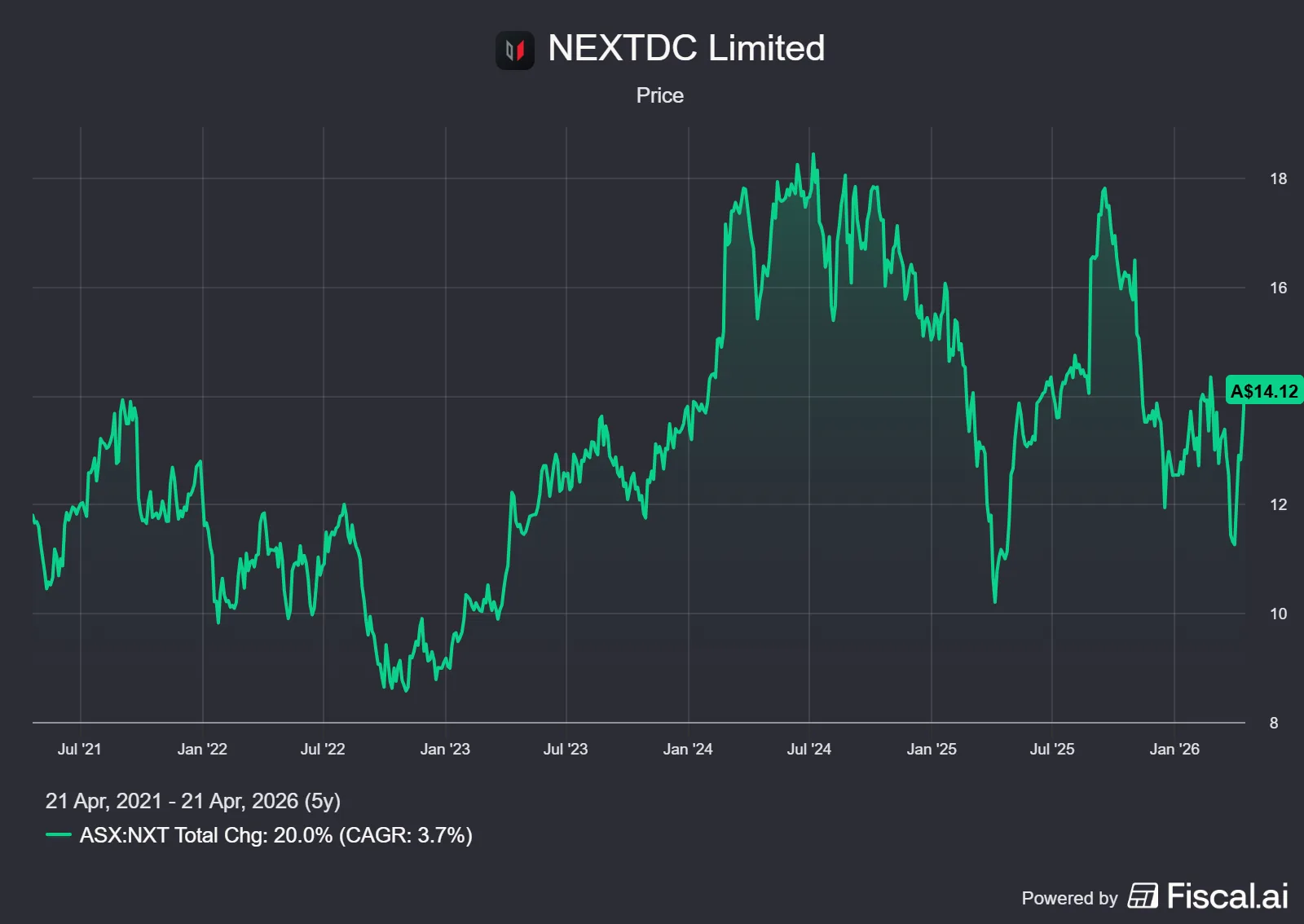
What has brought about NEXTDC’s rise?
The trigger was a 250-megawatt contract at its S4 facility with an AAA-rated counterparty, widely speculated to be Microsoft.
NEXTDC says customer commitments now point to $1 billion of EBITDA by 2030, versus current-year EBITDA guidance of $235 million. That is a staggering uplift, albeit, some time away. It does go some way toward explaining why CEO Craig Scroggie was willing to dilute shareholders again.
But the more interesting part of the announcement was not the raise itself. It was the shot Scroggie took at private rival Firmus.
Wait, who is Firmus?
Let’s get to the heart of what Firmus actually is.
Firmus doesn’t see itself as a traditional data centre landlord. The company is looking at cashing in on the data centre hype and listing on the ASX. It is pitching itself as a vertically integrated AI infrastructure platform. In English, a model that combines land, power, cooling, GPU clusters and compute monetisation under one roof. Firmus claims to have a contracted portfolio capacity of 155MW backed by 55,000 GPUs, although only 5MW is currently operational. The company wants to scale that to 3.3GW, with nearly US$8.2 billion of contracted value tied to two cornerstone customers, including Nvidia and an unnamed American tech giant previously identified as Meta. Contracts are take-or-pay, with an average term of 4.8 years.
Firmus is also pitching a very different funding structure. One that Scroggie has taken exception to.
Why the beef with Firmus?
Asked about Firmus on the analyst call, Scroggie questioned whether its proposed facilities could be built to the quality required by enterprise-grade customers.
He pushed back on Firmus’ claim that it can build capacity for roughly US$6 million per megawatt, versus an industry standard cited near US$12.4 million, and said if your business is merely producing tokens, you can build something closer to a warehouse than the highly redundant, security-heavy digital infrastructure platform NEXTDC offers.
In other words, the debate is not just about cost. It is about what kind of data centre is being built, who it is for, and whether lower-cost AI factories are genuinely comparable to premium colocation assets.
So what does all this mean for the sector?
First, demand is continuing to grow.
NEXTDC’s raise confirms the incumbents are seeing enough contracted visibility to fund multi-billion-dollar expansions now; it’s no longer a pipedream.
Second, the market continues to evolve. Traditional operators like NEXTDC are selling proven resilience and execution for large customers needing mission-critical infrastructure. New entrants like Firmus are selling AI, speed to deployment through their neocloud models. These models operate in the same ballpark, but differ.
Third, capital intensity is becoming the defining feature of the industry.
The question becomes: can NEXTDC continue to tap the capital well? Can demand simply be extrapolated out? Perhaps in the short term, we’re in the middle of an AI gold rush.