

Audinate Group Ltd (ASX: AD8) revenue growth returns but the business model, video and control remain a watch in Audinate’s HY26 result.
The Audinate pivot continues from a hardware-centric business to focus on a software-defined platform for the entire AV ecosystem, across audio, video and control.
In Audinate’s HY26 result, revenue increased 12% to US$21 million equating to a 12% lift in gross profit to US$17.4 million. The company had previously guided to gross profit growth of 13% to 15% and has maintained this growth for the full year.
While underlying operating expenses (excluding acquisition and restructure costs) grew 26%, a touch ahead of the 25% full year guide. In positive news, the company forecasts a 20% increase in operating expenses in the second half, down from 25%.
As a reminder, Audinate develops and sells AV-over-IP solutions that enable the distribution of audio and video signals over standard computer networks.
Having been slightly under full-year growth expectations and flat half-on-half revenue growth, the Audinate share price was down 10% on the day of release, to $3.36 per share. Quite the chart:
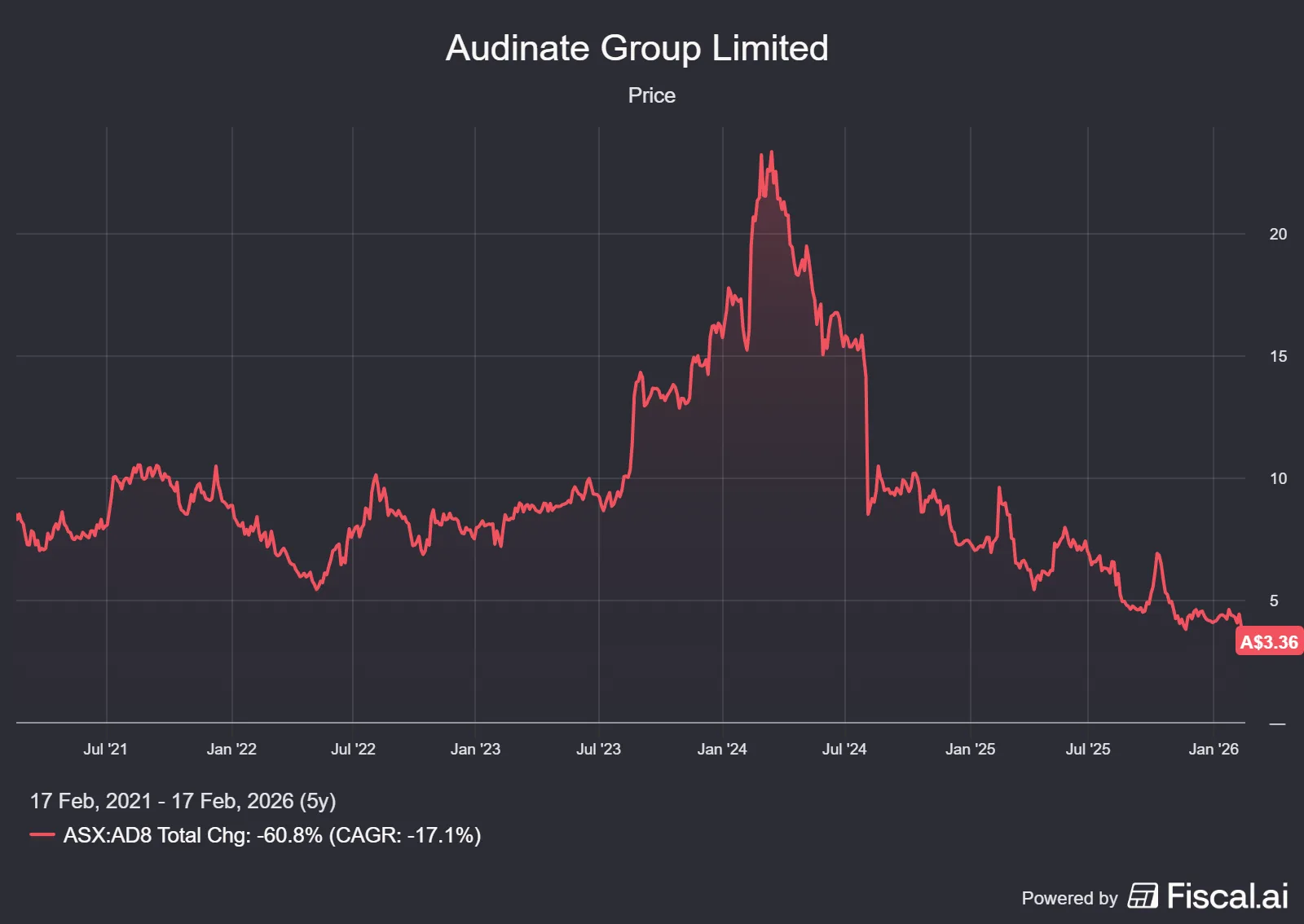
At the time of writing, the share price has rebounded around 8%. However that does not make much of dent after shares have declined over 60% in the past 12 months.
Audinate HY26 results key points
Here are the key points from Audinate’s HY26 result:
- Revenue +12% to A$32.2m (US$ 21.1m, +12%).
- Gross profit +12% to A$26.6m (US$ 17.4m, +12%).
- Gross margin held at ~82.5% in A$ terms; US$ gross margin improved slightly to 82.6% (from 82.2%) due to favourable mix toward higher-margin software.
- Underlying EBITDA swung to a loss: (A$2.3m) vs +A$0.8m pcp.
- Reported EBITDA: (A$5.5m), reflecting restructuring costs (A$0.8m) and Iris acquisition-related payments (A$2.5m).
- Net loss after tax: (A$10.6m); loss per share 12.68c.
- Cash + term deposits: A$70.9m at half-year end (down from A$109.9m at 30 Jun), mainly due to the Iris acquisition payment.
- Operating cash flow: (A$0.5m) (vs +A$1.2m pcp).
- Free cash outflow: (A$9.0m) vs (A$8.1m) pcp.
- Adaptor sales +51% driven by new “AVIO for installation” products.
- Embedded software increased 17% on higher OEM adoption of Dante IP Core.
- Embedded Chips Cards and Modules slightly down: -4% as the market continues transitioning toward embedded software implementations. This is a sign of lower demand for Audinate’s Brooklyn/Ultimo product.
- Platform software +9% helped by DVS Pro, early wins for Dante Director
- Design wins: 66 in the half, +8% vs pcp.
- Dante-enabled products in ecosystem: 4,947, with 344 new products launched during the half.
- OEM brands shipping Dante products: 516; 207 OEMs developing new Dante-enabled products.
- Management says 1H bookings were strong and support FY26 full-year outlook.
- FY26 outlook remains US$ gross profit growth of 13–15% over FY25, with gross margin expected to remain broadly in line.
- Operating cost growth now expected to be ~20% over FY25 (previously indicated 25%), after organisational changes.
What happened
The first half result is a continuation in the shift of Audinates business model which began in FY25.
The catalyst for change was ugly but largely cyclical. Original Equipment Manufacturers (OEMs) over-ordered post-COVID, inflating prior-period sales, and then entered a “destocking” phase that pulled demand forward, leaving FY25 looking weak. As a result, FY25 revenue fell from roughly US$60m to US$40m.
At the same time, the mix change started to show. Increasing software and lower hardware revenues meant that, while revenue dropped, gross margin rose to around 82%. Operating earnings (EBITDA) was then obliterated. It is worth noting that management now anchors guidance to US$ gross profit growth (13–15%) and their performance incentives rather than revenue. In a software transition, gross profit should grow faster than sales as mix improves, which is directionally correct, but also arguably “easier” as a performance hurdle.
That FY25 pivot is clearly visible in the first half of FY26. The newly acquired Iris video platform has been commercially launched, but it remains financially small today (only A$0.1m of revenue and a A$2.0m loss since acquisition). It still required continued go-to-market and product investment. Whether Audinate can add video (Iris development) and control (Dante Director) to become the go to solution for the AV ecosystem in my opinion is the long term thesis here, and will drive the future growth of this company.
Movements in the cost profile
Reported operating costs rose about 41% (or 26% on an underlying basis after adjustments), capitalised development increased to A$6.0m (including Iris), and total R&D reached A$8.65m (27% of revenue).
Cash fell to A$70.9m mainly due to the Iris payment, with free cash outflow of A$9.0m. In short, the platform ambition is progressing, but at a cost. As with all software businesses investors should watch capitalised development closely as this can be hidden away in the cash flow statement and can make reporting metrics like EBITDA cover up true business performance.
Audinate is pushing for 2–3x industry growth (vs an estimated 4–5% industry baseline) and positions Iris for a future where AI-driven video workflows make software-led AV control more valuable. It still boasts 14x the market adoption of the closest competitor in audio; it remains the gorilla in the audio jungle.
What it means and the outlook
Looking ahead to the remainder of FY26, management must execute. Audinate has reiterated US-dollar gross profit growth of 13–15% over FY25, supported by strong 1H bookings and forward orders, with gross margin expected to remain broadly in line as the software mix improves. Operating cost growth has been trimmed to ~20% (from 25%) after first-half organisational changes.
In my opinion, the key items to watch are the 2nd and 3rd divisions of Audinate, being video and control. Audio is a lock, and Audinate is dominant. But the key for this company is the success of its transition into video and the control platforms. There still may be some short-term pain with continued investment required.
I will continue to hold my position, grit my teeth, and know that, in the long term, the dominant player audio thesis remains intact, but the next stage of the company depends on success in the 2nd and 3rd divisions. I expect to see continued progress in these segments at the full-year result, but I’m not rushing to add to my position.