
ASX Ltd (ASX: ASX) half-year results showed 11% revenue growth, but ASIC inquiry costs, higher capex and a CEO exit kept investors cautious.
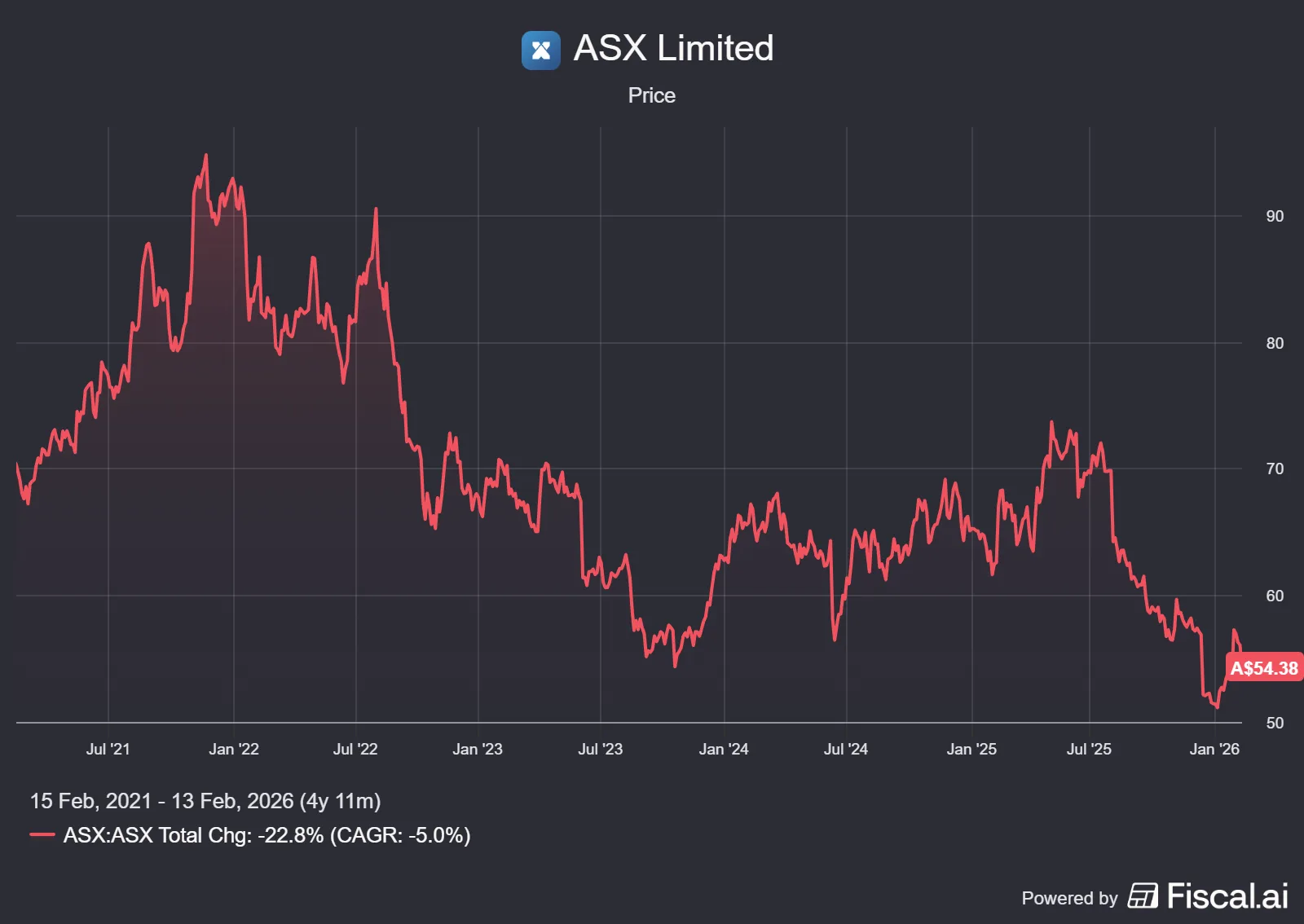
The ASX share price pulled back 1.7% on the day of release, despite double-digit revenue growth. Regulator issues and a CEO exit continue to weigh on the company.
The ASX runs Australia’s core market infrastructure.
The ASX hardly needs an introduction, but we will anyway. It does a bunch of administration work for equity markets, settlements, transactions, etc. In simple terms, it earns fees when companies list and raise capital, when investors trade, when participants clear/settle, and when institutions consume data and connectivity.
What drove the ASX Ltd half-year result
Some of the key points from the six months to 31 December 2025:
- Operating revenue: $602.8m (+11.2% pcp), with higher revenue across all four business lines.
- EBITDA: $370.4m (+8.2%); EBIT: $338.5m (+5.3%).
- Statutory profit after tax: $263.6m (+8.3%).
- Net interest income: $40.2m (-6.7%), reflecting lower interest earnings on its cash balances, plus increased interest expenses on leases.
- Total expenses: $264.3m (+20.0%), including $17.3m of ASIC Inquiry costs. Excluding inquiry-related costs, ASX reported core expense growth of ~12.1%.
- Interim dividend: 101.8 cents per share (down 8.5% pcp), the ASX paid out ~75% of underlying profit (down from ~85% pcp).
- Capex: $83.1m in HY26; ASX reiterated FY26 capex guidance of $170–$180m (excluding ~ $10m office fitout capex, its non-operational) and FY27 capex of $160–$180m.
- Cash & equivalents: $700 million down from $1 billion in June 2025, largely due to movements in operating assets, capex and dividends paid.
What happened in this result
Revenue rose strongly as trading, clearing and settlement activity increased.
While the company recorded double-digit revenue growth (11.2%), ASX grew core expenses by 12.1%. The ASX increased spending on major programs, including technology modernisation. The company absorbed ASIC Inquiry-related expenses following an interim report by an expert Inquiry Panel appointed by ASIC to assess the company’s governance, capability and risk management practices. The additional $150 capital investment strained the company’s dividend.
The result comes just two days after the company announced Chief Executive Officer Helen Lofthouse would be stepping down.
What it means for the ASX
While market activity remains elevated, the ASX’s core business still produces reliable earnings.
The technical issues, governance queries, and the ASIC imposed capital overlay will continue to weigh on the ASX in the short term. Perhaps a change at the top will help correct some of these issues and a few of the outages experienced recently.
The ASX is in its final preparations to deliver the first phase of the CHESS project, which is targeting go-live in April 2026. Hopefully smoother than some of its previous ventures.
Looking ahead
The ASX reiterated FY26 total expense growth guidance of 20–23% including ASIC Inquiry/commitments costs, and 13–15% excluding those costs.
The company plans to provide FY27 total expense growth guidance by the end of the financial year, and it expects FY26 ASIC Inquiry response costs to be “one-off” in nature.
Delivering earnings per share of $1.36 in the first half, if we were to apply a simplistic annualistion and estimate $2.72 per share for the full year, at a share price of $54.44, the ASX would be trading on a price to earnings ratio of 20. While not screaming cheap and with some headwind compliance issues I would continue to watch from the sideline. With its monopolistic type position there is definitely potential at the right price.