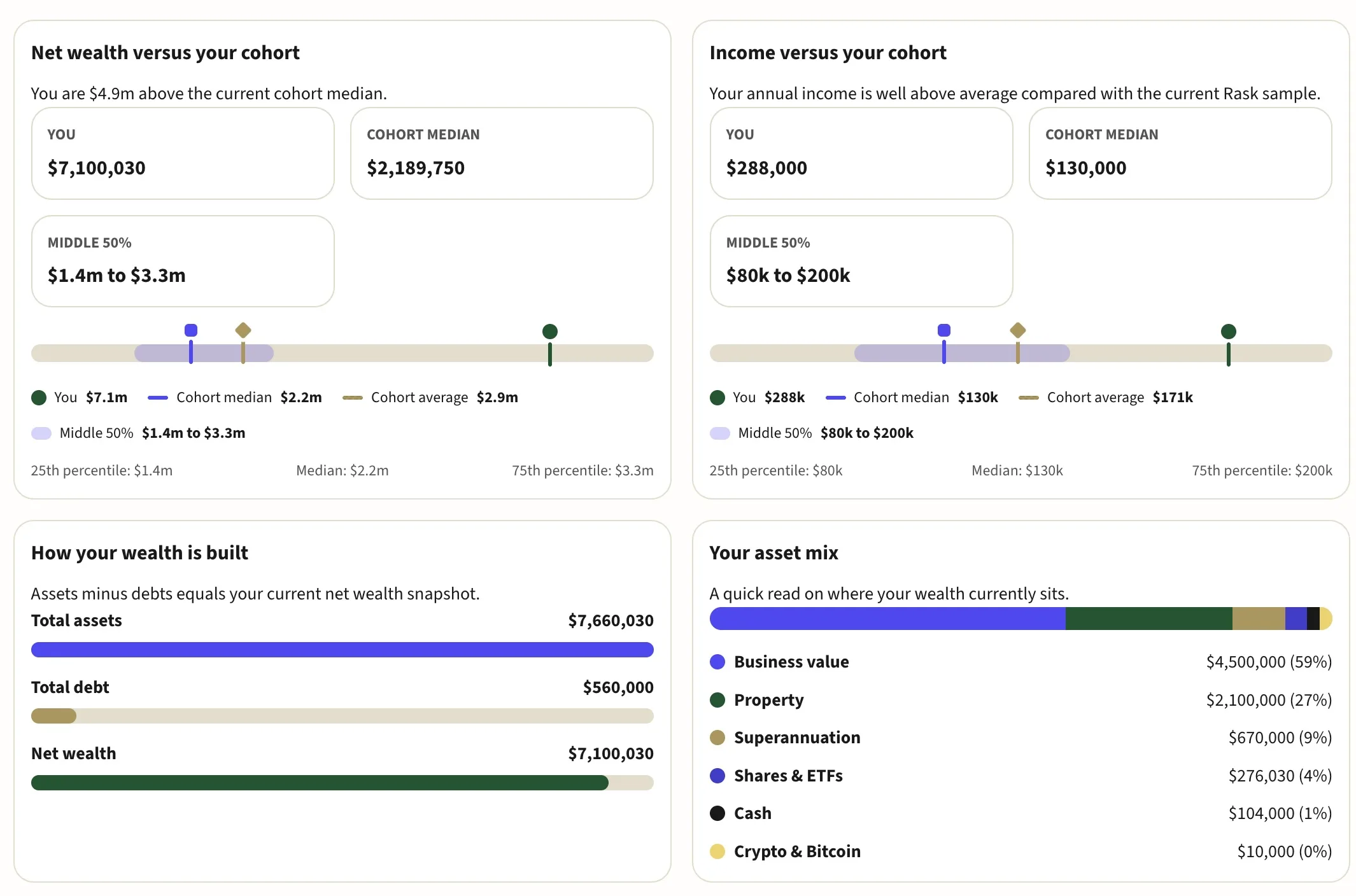


Most Australians build their wealth in the same two places, superannuation and the family home, with an investment property added later if there is room to borrow. And for most of the past few decades that has been less a deliberate strategy than a habit that quietly worked well enough.
Property kept rising and super compounded away in the background, and because the tax settings on both were generous, few people ever stopped to ask whether the structure holding their money was the right one for it. Both have been powerful ways to build wealth, but each comes with limits on getting at the money when you need it, because super is locked away until retirement and a property cannot be sold quickly, or in part. That question has become harder to ignore in 2026, because the most significant structural change to the taxation of superannuation in years came into effect on 1 July, and a few months on, the adviser conversation has already moved from understanding the policy to working out what to do about it.
Division 296 now applies an additional layer of tax to superannuation earnings on balances above $3 million, and for clients already at or approaching that threshold the effect is far from marginal. Our own modelling shows that once investment growth is factored in, a $5 million balance could generate more than $350,000 in additional tax over a decade, a real drag on long-term capital. While Division 296 has accelerated interest in alternative structures for Australians with more than $3 million in superannuation, the case for investment bonds extends well beyond high-balance super investors. The tax itself, though, matters less than what it exposes. For years the working assumption was that superannuation would always be the most efficient home for long-term capital, and at higher balances that no longer holds automatically, so once one of the two default structures begins to wobble it becomes reasonable to ask what else might be on the table. The conversation has been too narrow for too long, because most people treat diversification as something you do with assets, spreading money across shares, property and cash, while few think about spreading capital across the structures that hold those assets. Yet the structure can matter every bit as much as the investment inside it, since two people who own the same shares can keep very different amounts of them depending on whether the holding sits inside super, in their own name, in a trust or somewhere else. Where wealth sits shapes how it is taxed and how easily it moves.
Investment bonds are one of the structures that sit outside that familiar super-and-property default, and they are drawing renewed attention for reasons that have nothing to do with novelty. Friendly societies, the member-owned mutuals like ours, have offered them in Australia for well over a century, so what has changed is not the product but the world around it. The appeal is largely structural, because an investment bond is taxed internally, with earnings taxed inside the bond at a rate capped at 30 per cent and no requirement to report them on a personal return each year, and provided it is held for ten years, withdrawals are generally tax-paid in the investor’s hands, with no capital gains events when the investments inside it are switched or rebalanced.
In a system where tax settings shift with almost every budget, a known and capped rate offers a certainty that is easy to undervalue until you no longer have it.
None of this makes an investment bond better than superannuation, but it does make it usefully different. The difference is the whole point, because where super is built for retirement and locked away until then, a structure without preservation rules gives an investor access to capital before retirement age, whether for a career change, a child’s education, or a plan that happens to arrive at 45 rather than 65. There is also the question of what happens afterwards. Australia is at the start of the largest wealth transfer in its history, with trillions passing between generations over the coming decades, and superannuation does not always move cleanly across that line. Adult children who inherit a super death benefit can face tax of up to 17 per cent on the taxable component, whereas a structure such as an investment bond, which lets an investor nominate a beneficiary directly and passes tax-paid, can make the handover considerably simpler for many families.
The two-place habit will not disappear, nor should it, because superannuation remains the foundation of retirement planning for most Australians and the family home is far more than an investment. But the assumption that those two structures are enough on their own has quietly had its day, and the more useful question now is not which asset to buy next so much as where wealth should sit, how it will be taxed over time and how it will eventually pass on. This means thinking in structures rather than assets, and being willing to look past the two that have always been there.