

The recent Xero Ltd (ASX: XRO) share price weakness has raised a fair question for investors, can this ASX software darling still justify its premium in an AI-shaped market?
Xero still has one of the stickiest business models on the ASX.
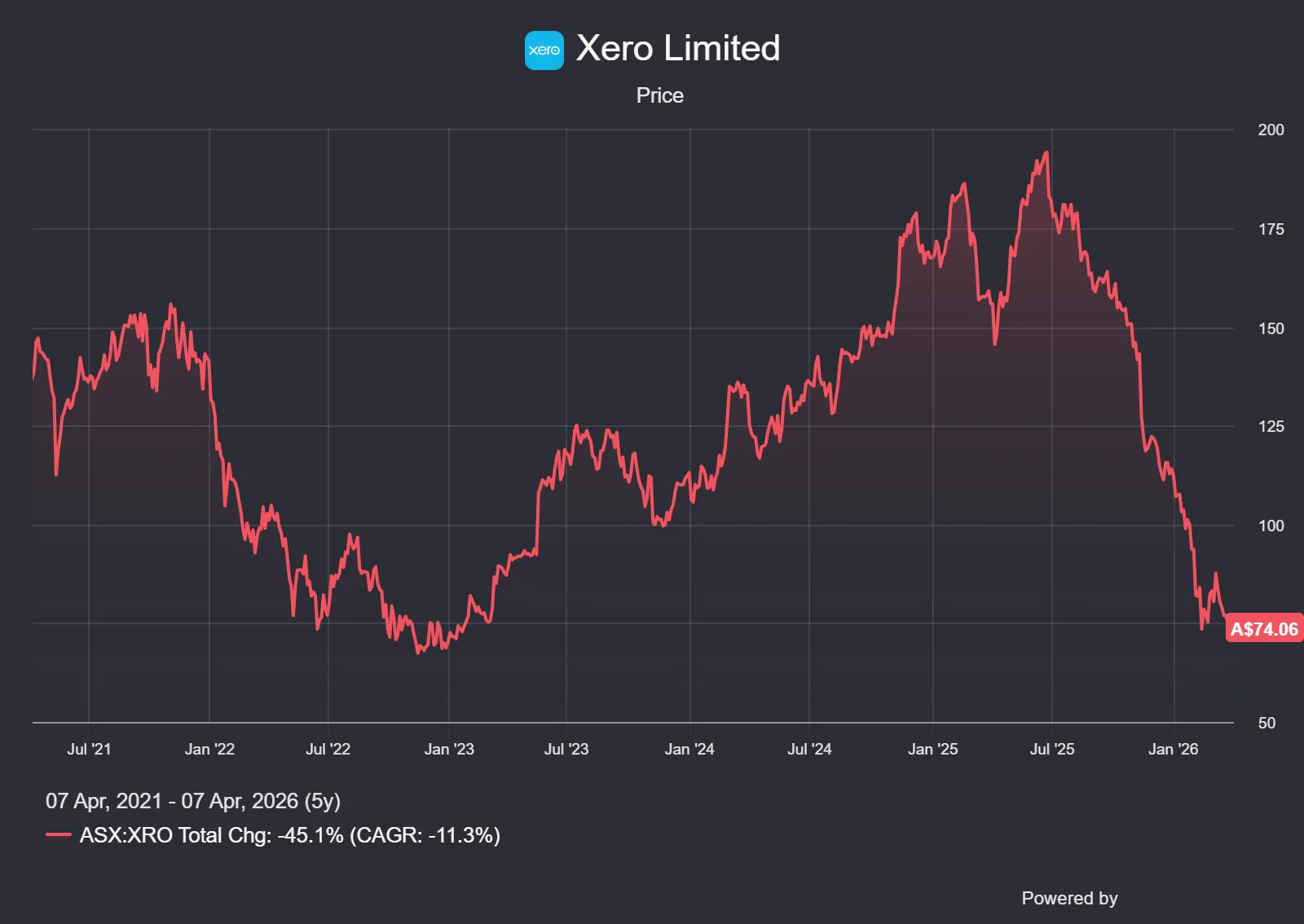
The company remains at the heart of small-business financial workflows: accounting, payroll, payments, reporting, compliance and advisor connectivity. Its customers are embedded and the low churn shows they rarely leave. The Xero share price is lingering in the $70’s which is a long way off threatening the $200 per share it flirted with 9 months ago. What has changed is the software landscape. The fear spread by the apparent ‘SaaSpocolypse’, whereby everyone is going to code their own enterprise software. While that is obviously extreme, Xero’s competition is likely to ramp up, as new AI tools allow existing software providers a faster way to create competing products.
Couple that, with an expensive acquisition of Melio. Just when you thought chief executive Sukhinder Singh Cassidy had her eye on sharpening the existing core business, Xero went out and bought (so eloquently put by Mitchell Sneddon) a new cash oven, which, if it goes the way of other expansive Xero acquisitions, may lead to further incineration of shareholder capital and pressure on the Xero share price.
Time will be the ultimate judge.
So what is the current state of play with Xero? Is the sell-off in Xero’s share price justified?
How big of a threat is AI?
Singh Cassidy has long pushed back on fears that AI can easily replicate the company’s core accounting software.
Singh Cassidy argues that Xero’s advantage lies not just in workflow tools but in its proprietary transaction data, banking infrastructure and thousands of bank feeds that would be difficult for a casual AI-built clone to match. It is her belief that investors are treating all software as equally vulnerable to AI disruption when, in Xero’s case, the underlying data and infrastructure create a stronger moat. Xero’s management is instead framing AI as an expansion opportunity, with new agents already creating invoices, reconciling accounts and answering business questions through Just Ask Xero (JAX). Xero said about 2 million of its 4.6 million subscribers are using traditional AI features and 300,000 are already using newer generative AI tools launched only months ago.
The company expects to begin monetising its new AI features in 2027, while also reaffirming its Melio guidance (reach Adjusted-EBITDA breakeven on a run-rate basis in H2 FY28) and highlighting Melio as a key driver of future US growth.
I believe you can mount an argument that AI is Xero’s biggest threat. Accounting isn’t going anywhere, but perhaps competition heats up, and it’s now easier for another company, perhaps outside of accounting can slot a new accounting offering within its tech stack, and absorb some of the fee. In days gone by this would have taken years and been at high cost. Not anymore. Potentially eroding some of Xero’s pricing power.
Xero partners with AI giant, Anthropic
In what could be argued a defensive move, Xero has partnered with Anthropic to embed Claude into its accounting platform, automating tasks such as chasing unpaid invoices, preparing financial reports and enabling customers to analyse their financial data directly within Claude’s interface.
This is in the face of concerns that have grown around increasingly powerful AI tools which could allow customers to build their own workflows or reduce the number of software subscriptions they need. To be fair, I can’t see a tradie vibe coding his or her own accounting software. By bringing in the big guns, Anthropic joins OpenAI in supporting the accounting softwarre become more useful and develops “super agent” directing sub-agents to complete specific accounting and finance tasks.
Xero’s valuation
That brings us to valuation.
My view is that software valuations may never again command the same broad, indiscriminate multiples they once did. Software isn’t dead, but the market is now more aware of increasing competition. The old market habit of paying premium multiples simply because a business was recurring-revenue software looks far less likely to return. Investors now want profitable growth, durable data ownership, real AI execution and evidence that the product remains central even if the interface changes.
Xero currently trades on a 4.85x multiple of its estimated next 12 months revenue.
In a surprise to nobody, this is around the 5 year lows with a high of 23.7x and an average of 11.8x. While it does provide a guide to where Xero is at, revenue multiples can be murky. Adding in Melio and a shift in business characteristics can blur the comparative. It also doesn’t take into account what comes after revenue in the P&L.
So, can Xero still be one of the best tech stocks on the ASX?
Yes, but the bar is higher. The bull case is no longer “great SaaS, high multiple, long runway.” It is that Xero remains deeply embedded in small-business finance, has real scale, is broadening its monetisation through payments and platform expansion, and is taking the sensible route on AI by pushing it into the workflow rather than pretending it changes nothing. The bear case is that AI increases Xero’s competition, erodes its moat and that new oven gets cooking.
Xero can still win, but it has to earn its premium every year.