

Baby Bunting’s (ASX: BBN) delivered a stronger-than-expected HY26 result, with record gross margins and improving sales momentum.
The company’s first-half result reflected solid trading and an expanding gross margin, meaning it kept more profit on each sale. This strength was partly offset by higher operating costs and disruption from store refurbishments and network optimisation.
At its AGM, management guided to 2–3% growth in first-half comparable sales, which measures revenue growth from existing stores, and pro forma Net Profit After Tax of $4.5–$5.5 million. Pro forma earnings exclude share-based payments and transformation costs, giving a clearer view of underlying performance.
The final numbers landed at the top end of, and slightly above, management’s expectations.
Baby Bunting delivered +4.7% comparable sales, comfortably ahead of the AGM range, while falling in the mid-range of pro forma NPAT guidance at $5.0 million.
Across nine refurbished stores, average sales in the half are up 25% across these refurbished stores since reopening, which is at the top end of their 15%-25% uplift target. It did note higher than expected costs in relation to the renovations, but that didn’t dampen the markets reaction.
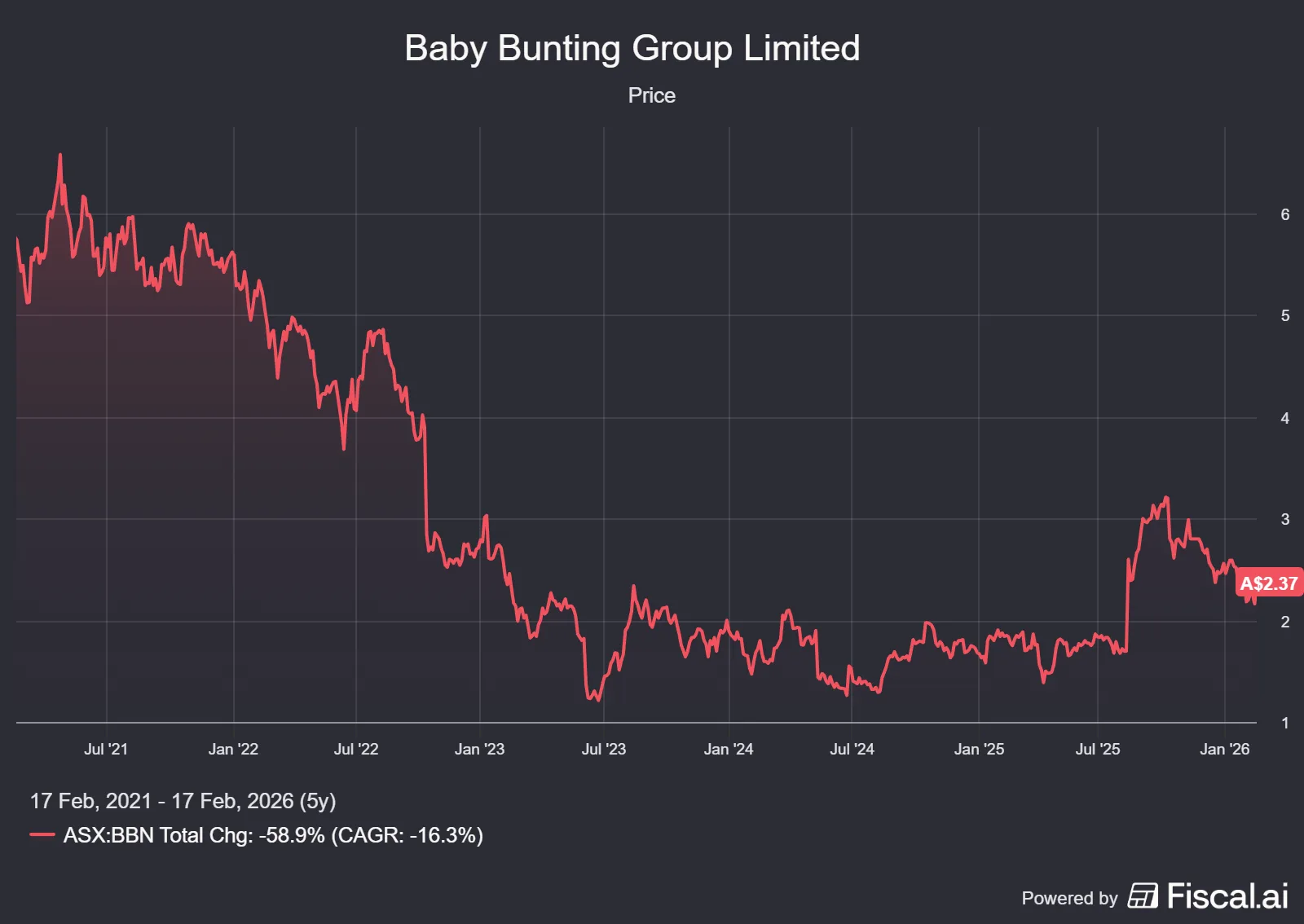
The share price closed the day 8.64% higher at $2.39 per share.
Key points behind Baby Bunting half-year results
- Sales $271.4m (+6.7% on last year) with comps +4.7%, ahead of the company’s 1H comp guidance (2–3%).
- Gross margin 41.0% (+124 bps) a record first half, driven by supplier terms and product mix (private label/exclusive).
- Pro forma NPAT $5.0m (+4.1%), in-line with guidance; statutory NPAT $1.8m (-52.5%) after equity incentive costs and other adjustments.
- Online continued to outgrow: online revenue (including click & collect) was $67.2m (24.8% of sales) and grew strongly versus the prior period.
- Cash of $5.1 million, down from $12.4 million in June. Operating cash flow was higher, although it was soaked up by the refurbishments and the company relied on debt drawdowns.
- No interim dividend, with net debt higher as capex accelerates.
- Pro forma full year guidance increased to between $17.5 million to $19.5 million (previously $17.0 million to $20.0 million).
- The first 7 weeks of trade has seen 6.7% comparable sales growth.
What happened
The refurbishment plan is underway, with the new stores driving a 25% increase in sales over the past 6 months.
The goal of the ‘store of the future’ upgrades is to continue to attract new customers to the stores, this led the growth and improved underlying trade. Management highlighted customer base growth and a better delivery proposition, including a move to 100% store-based fulfilment for online orders.
Improved supplier terms and the product mix shift toward private label and exclusive products were the key drivers of margin expansion to 41% and the 10% increase in gross profit.
Costs rose faster than the top line. Pro forma Cost Of Doing Business (CODB) increased to $96.8m (35.7% of sales), driven by wage inflation, new and restructuring store costs and marketing. The investment phase of the new store venture shows up in the statutory (the real) profit, delivering $1.8 million of profit after tax, compared to Baby Bunting’s underlying number of $5 million.
Despite the increase in gross margin, these additional costs dragged down operating margins.
Outlook and guidance post Baby Bunting’s half year result
Baby Bunting maintained its second half pro forma profit after tax guidance of $12.5 million to $14.5 million, and following the first half pro forma profit of $5 million, has updated full-year guidance to $17.5 million to $19.5 million.
There are a couple of key items to meet in order to achieve this:
- full-year comparable sales growth of 5–7% (increased from previous guidance of 4% to 6%), with second half growth of 6% to 8%,
- gross margin above 41%,
- continued CODB investment tied to new stores and refurbishments, and
- FY26 capex $41m–$43m (excluding rent-free landlord contributions).
There are obvious signs that the store upgrades are having an impact, albeit at a cost. Early stages of the second half show strong comparable sales growth; the former market darling could be on the up. Execution risk sits in rollout timing, disruption days, and controlling CODB/net debt. If improvements can continue and costs are kept under control, this could be a great story to watch in 2026.