
Building a business isn’t easy.
Sure, anyone can ‘register’ a business using business.gov.au in a matter of minutes.
But without dedication, planning and smarts, your entrepreneurial journey is destined for the business boneyard. This email is for everyone who invests, runs a business or has high aspirations for their career…
How I’ve built Rask
It must have been a few years ago now…
Having coached so many business owners. And invested in dozens of companies over 10 years.
I sat down to create a flowchart of how I think about all businesses, and the cogs that go into making them run as effectively as possible.
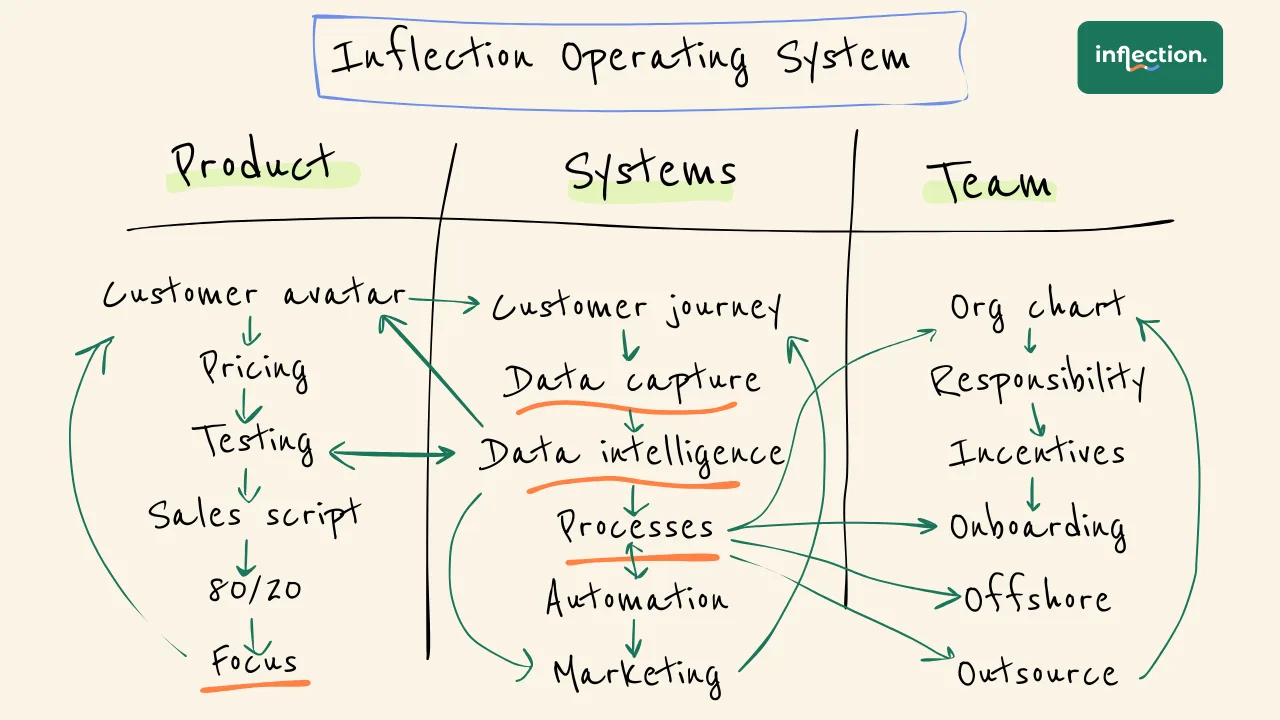
After co-founding Inflection, the business owners’ community, I created the Inflection Operating System (and yes, it can be shortened to a cheeky acronym).
The IOS solved for two types of people:
“I feel like I’m just making it up.” – business owners everywhere.
“I don’t know why my boss doesn’t listen to me.” – managers and team members everywhere.
This weekend’s email goes deep.
We’ll predominantly focus on the business owner side of the equation – but if you want to be a better manager, leader or investor in private or small cap businesses, understanding these concepts is critical.
Let’s dive in…
Product
Any business can be divided into three areas:
1. Product/service – the things you sell.
2. Systems – how the things get done.
3. Team – who does it.
All good businesses start with a customer avatar (and industry research) because, without knowing who the customers are, how can you solve their problem with a product or service they’ll actually pay for?
“Who are you selling to?” is an incredibly simple question that so many business owners can’t answer.
If you try to be everything to everyone, you’ll be nothing to anyone. In 2022 I explained how to create a customer avatar, step-by-step.
Once you know you’re talking to Beth, Bill or Bronwyn, you can start to more effectively price your product. Most business owners feel deaf, blind and mute in a room of potential customers, so they really struggle to price their products with conviction. They often end up just copying their competitor, with 10% higher or lower prices.
Navarre from Navexa taught us a step-by-step formula to price your products – even if your business doesn’t exist yet. It involves a lot of testing, which you record and store to build on your business intelligence through data. Pricing informs everything, especially the sales process.
Most people think selling is an art, and not a science. If you think that, how do we predict the weather? The answer: lots and lots and lots of pattern recognition, built on mountains of data. Most businesses don’t use a sales script, even a few dot-points, despite its crucial importance (salesmen and saleswomen are not known for their structure).
The direct result is that most businesses rely on simple conversion rates, which are powerful: Greg did 100 sales calls and got 20 clients; Susie did 100 calls and got 10. Greg is better.
With AI seeping through every crevice of business operations, eventually even the salesmen and women will be held accountable. I’m seeing this already: AI can instantly analyse even the most unstructured and loose call transcripts, then recommend staff training, scripts or performance improvement plans (or redundancies). Ultimately, this is about building a hive of intelligence, built on data – not vibes, that allows a business to flourish.
Once you have done that, it’s about using the 80/20 rule to refine your business model. Simplify, simplify, simplify.
Phil Thompson recently told us that having multiple products or services multiples complexity. It’s not a simple addition.
Many bakers say to themselves, “If I do baguettes, I may as well cook up and sell some bahn mi!”
In doing so, they have to market 2 products, make 2 products, order different ingredients, prepare the kitchen in different ways, and so on. On the surface, bahn mi seems like a great idea to boost revenue – but how many layers of complexity does it introduce?
The power of focus is real. I’m convinced it’s the enemy of traction. And probably the biggest destroyer of businesses. Remember, good ideas are cheap. Everyone has them. But good execution is extremely expensive. Because few people actually devise a plan and implement it till the end.
(Just ask every armchair expert watching the footy – the bloke who’s never kicked a goal in his life often has the most to say!)
Systems
Chances are, you know a business owner who has a few scars wrapped around a lifetime of lessons on things that do or do not work. Somehow, they just know the answer to ideas or strategies you put forward.
The problem is, most business owners don’t have the time or method to take that from within them and spread it through their team. Telling your team ‘why’ you decide not to go ahead with their idea is a good start (it gives them a chance to challenge your belief).
But we, business owners, did find a way to share everything we knew – and fostered a great team environment – we would finally be able to go on a holiday.
Again, systems start with the customer. As Amazon has shown us time and again, every business must be customer centric. The customers fuel your business. So their interactions are critical to survival. What do they feel each time they interact with you?
I often use the example of Apple v Microsoft products – with Apple, it doesn’t matter if you pick up a 2014 MacBook or an iPhone from 2025. The look, feel and brand strategy are almost identical. By contrast, you could pick up a Toshiba or a Dell and have a very different experience with Microsoft. Don’t be Microsoft. Have some values, and stick to them. This creates customer loyalty.
If you’ve read a book like Permission Marketing by Seth Godin you’ll know that every interaction with a customer is a chance to ‘get more permission’. You can only do that by capturing data. Seth’s book gave rise to an industry – CRM software – that now generates billions of dollars per year in revenue. It’s an industry built on the premise that the more you know, the smarter your decisions.
In other words, data intelligence. Instead of going to the boss with 1 million questions about trivial things or seeking knowledge on a customer, you can leverage the intelligence of the collective/business via the existing data (assuming they’re recording and categorising it). From there, every decision becomes easier. And as AI rolls through every industry, this particular cog in your system will either prove to be your greatest strength or your biggest blind spot.
From the data we can simply and easily build better processes, like a McDonald’s kitchen, and from there, we can automate. Everything that can be automated will be automated. Why? Because it’s orders of magnitude cheaper and more consistent for a business, team members (especially in training) and customers to be on the receiving end of automated workflows based with clean processes.
All of this data then informs your marketing. If I had a marketing agency for every time a business owner who was struggling for customers said, “let’s do some Google ads” I’d be the gorilla of marketing – except I’d have a much better reputation. The reality is, marketing is a numbers business – with some creativity that joins the dots. Good marketing starts long before Google Ads.
Team
The final pillar is the hardest. Most small businesses (under 20 people) don’t have an org chart. And that’s okay, for a while.
You see, many people have told me the hardest part in any business journey is between 5 and 20 team members because the business owner is stretched thin, the team members don’t have the systems and management layer in place, and the organisation quickly descends into chaos if the culture isn’t watertight.
My business grew rapidly to 10-15 team members twice, then fell back to 1 (just me) after the Royal Commission into Banking and Finance. The second time, it went back to three.
A basic org chart could be as simple as two roles to begin with: Operations, Sales & Marketing (because most businesses outsource accounting, IT, etc., in the early days). Over time, you can get a finance manager and/or office manager. Then an Ops Manager. Head of Sales, and a Marketing Manager. But the key unlock is the documented processes (from systems).
Without documented processes, you can’t set responsibilities, incentives or KPIs, and recruit at scale. As Richard White told us, you have to go slower today to be faster forever.
At different stages of your business, you will find yourself having to outsource or offshore to fulfil customer outcomes. If you’ve ever tried working with offshore team members, you will know the vital importance of processes and managerial responsibility long before you salivate at the idea of ‘lower wages from overseas’.