


Why bank headwinds are creating a new reality for ASX shares

VanEck’s Russel Chesler explains the headwinds facing ASX bank shares and what this means for Aussie investors.

You’re reading a free article on Rask. Join 4,000+ Australians who get our expert advice, tools, exclusive research and investment recommendations. Get your 30-day trial for $1! Learn more

VanEck’s Russel Chesler explains the headwinds facing ASX bank shares and what this means for Aussie investors.

Earlier this month, KPMG issued a report, The new reality for bank profitability, which highlighted the serious profitability and growth challenges Australian banks are facing in the aftermath of COVID-19.

As a result of the record low rates and squeeze on net interest margins (NIMs), banks face pressure to manage costs and increase productivity. With the RBA unlikely to raise rates in the short term, banks will continue to face ongoing structural headwinds.

Since Australia’s “recession we had to have” in 1994, Australian banks have benefited from a growing economy in which home loan lending and credit growth thrived. This growth drove the banks’ profits to record levels.
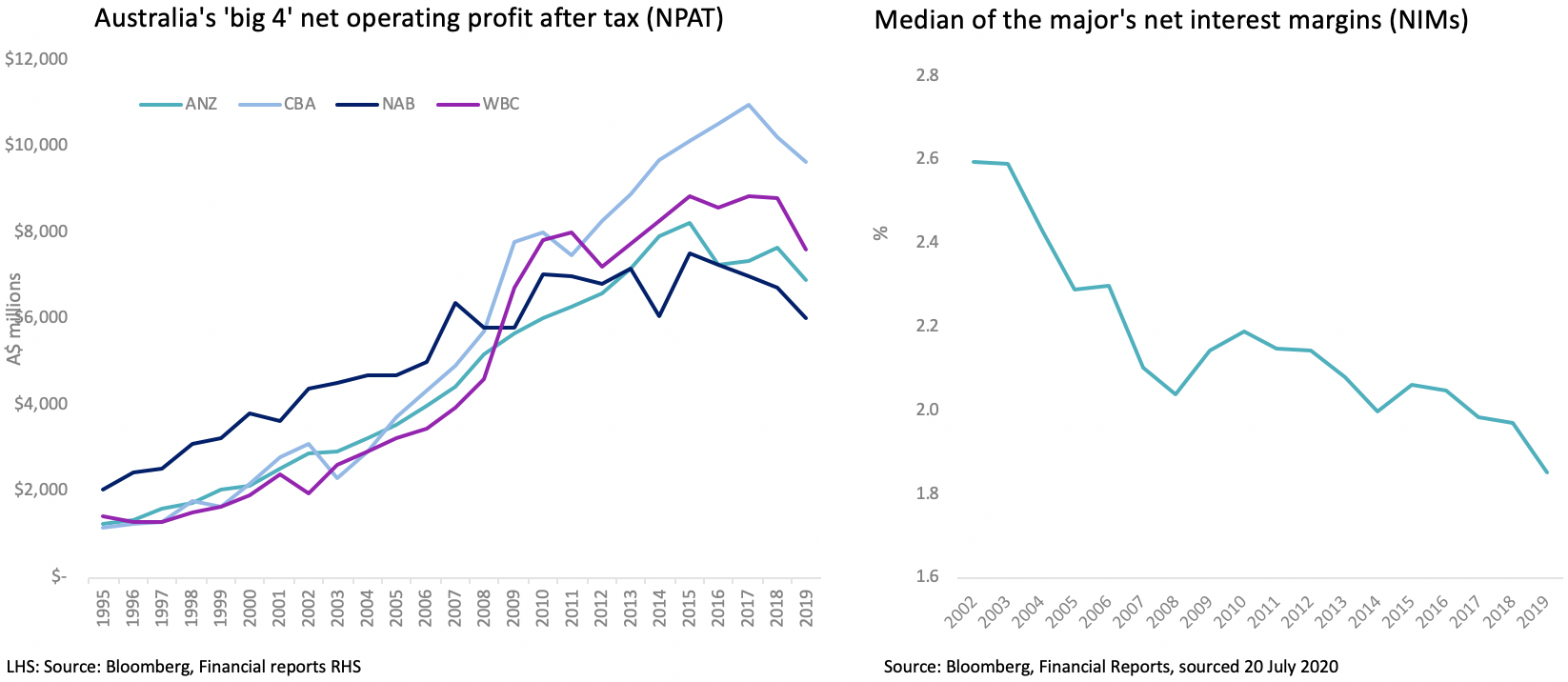
As you can see, banks were already facing headwinds in 2019 as the RBA loosened monetary policy, and we expect profits to fall further in 2020. Banks’ profits are sensitive to the mortgage market and according to KPMG’s report, it is estimated that every 5 basis points reduction in mortgage NIM results in a 1-2% reduction in cash earnings for the major banks. NIMs remain under pressure.

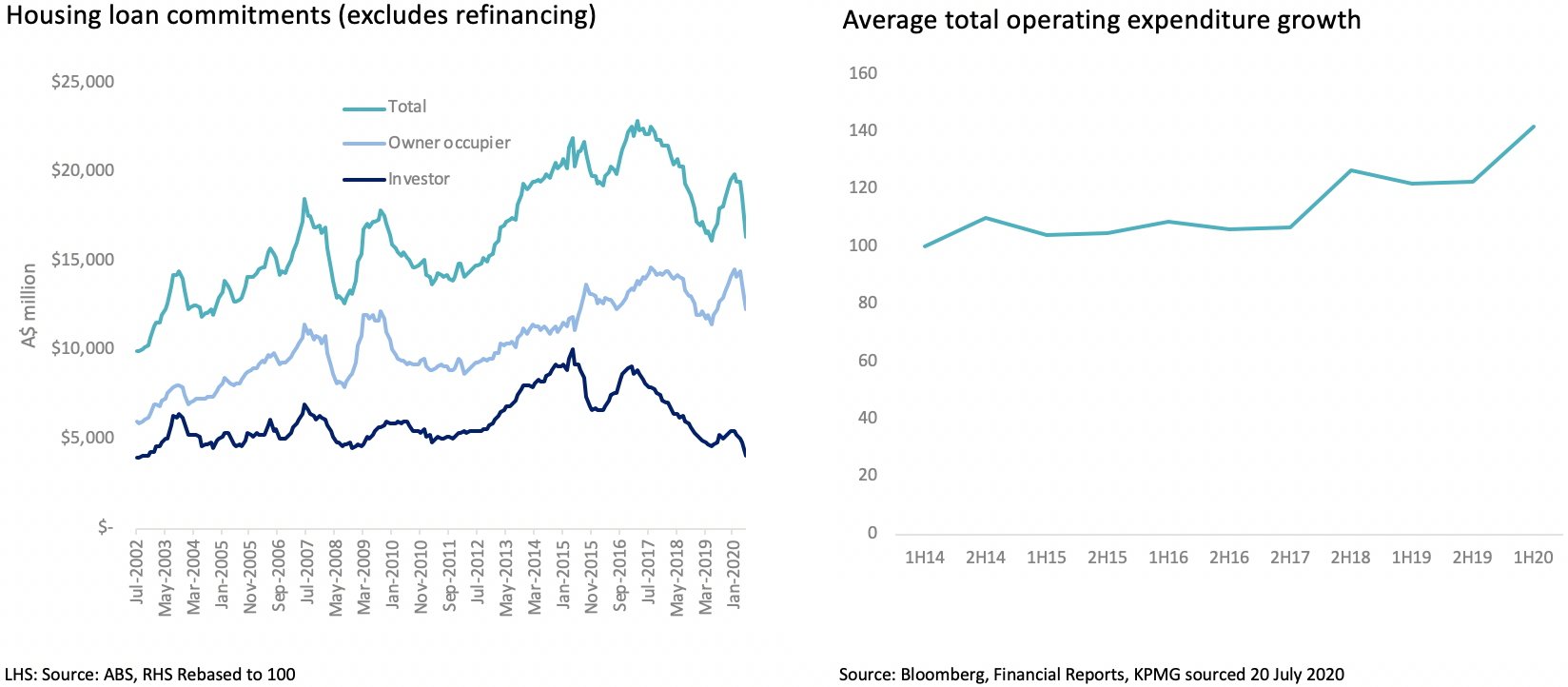
Having previously relied on mortgage growth for their burgeoning profits, Australian banks now have tough challenges as home loan lending slows but costs continue to rise.
What does this mean for ASX investors?

These headwinds are highly problematic for ASX bank shares and for the many Australian investors whose portfolios have significant exposure to the big four banks. They don’t bode well for sustaining current dividend payout ratios.

The four pillars (CBA, Westpac, ANZ and NAB) represent a quarter of the S&P/ASX 200 (INDEXASX: XJO). In other words, if you hold a blue-chip portfolio or are invested in an active or passively managed Australian equity fund that tracks or benchmarks to the S&P/ASX 200, $1 out of every $4 is likely to be invested in banks and therefore, vulnerable to the risks they face.

Conversely, taking an ‘equal weight’ approach to the S&P/ASX 200 can provide true diversification across securities and market sectors, reducing concentration risk to the banks. We’ve written a lot about the importance and benefits of taking an ‘equal weight’ approach, where the same weight, or importance, is given to each stock, reducing concentration risk.

As an example, the VanEck Vectors Australian Equal Weight ETF (ASX: MVW

online pharmacy buy zoloft no prescription

) invests in over 80 of the largest and most liquid ASX-listed companies using an equal weight approach. MVW’s exposure to the big four banks is less than 5%. This dramatically reduces investors’ exposure to the big four, reducing concentration risk and reducing the impact of dividend declines. MVW is close to 2.5 times more diversified than the S&P/ASX 200, as measured by the Herfindahl Index.

Find out more about the MVW ETF by visiting the VanEck website.

This report was written by Russel Chesler, Head of Investments & Capital Markets at VanEck Australia. To get in contact with Russel, click here to visit the VanEck website.

CSL, Xero, ANZ... the ASX is beaten up

Right now, only brave investors are buying. Is ASX Reporting Season your KEY opportunity to act? Buy, or sell.

This coming Monday night, our two most experienced professional investors, Owen Rask and Leigh Gant, are hosting an exclusive and rare webinar on the what to watch this ASX reporting season. LIVE and free

With over 35 years of combined investing experience, join our Chief Investment Officer and Head of Content for our free Q&A.

We’ll be diving into results from CSL, Pro Medicus (ASX: PME), ANZ Bank and more. It’s absolutely free to join us. Take advantage of this volatility with our free playbook. Simply click here to view the topics.

Disclosure: This article was written by the team at VanEck, issuer of the MVW ETF.

A $50,000 per year passive income special report

Join more 50,000 Australian investors who read our weekly investing newsletter and we’ll send you our passive income investing report right now.

How can Rask help you?

About Rask

Learn more about us, our your community and our mission.

Rask investing philosophy

Nearly 15 years later.
It's still a work in progress.

Online investment community

You won't find our investment community on Facebook or Reddit because it's secure, free and available now.

Join 250,000+ podcast listeners

250,000 investors tune into the Rask podcasts every month. Find out why.

Find a financial planner

Australia's financial experts. At your doorstep.

Free finance courses

35,000 students have enrolled in free Rask courses. We're on a mission to 100,000.

Subscribe to Rask's free investor newsletter

53,000 Australian investors subscribe to our Sunday newsletter... and love it! It's free.

$50 million invested

We manage almost $50 million on behalf of Aussies. Discover how you can invest with us.

Better investing starts here.

Want to level-up your analytical skills and investing insights but don’t know where to start? Join 50,000 Australian investors on our mailing list and we’ll send you our favourite podcasts, courses, resources and investment articles every Sunday morning. Grab a coffee and let Owen and the team bring you the best  insights.

Subscribe to Rask's free investor newsletter

Kick off your week with our pick of podcasts, courses and investing resources to keep your finger on the Rask pulse!

Here you go: A $50,000 per year passive income special report

Join more 50,000 Australian investors who read our weekly investing newsletter and we’ll send you our passive income investing report right now.

Simply enter your email address and we’ll send it to you. No tricks. Unsubscribe anytime.

Unsubscribe anytime. Read our TermsFinancial Services GuidePrivacy Policy. We’ll never sell your email address. Our company is Australian owned.