
SpaceX Inc is expected to IPO it’s stock in 2026 – probably making Elon Musk even richer than his current $800 billion net worth. Is the SpaceX IPO something worth researching? I – Owen Rask, founder of Rask and a real space nerd – took a look at the business, expectations and answered an alarming question from a Rask podcast regular (see below). This article first appeared in our free investor newsletter.
~~~
A few months ago, the Rask team and I were sitting around a fire pit at our annual retreat.
And just after the sun went down, we saw this emerge in the sky:

I know it looks fake. But it’s not.
This is a photo I took with my iPhone, at 3x zoom, in the dark.
Naturally, when anything like this appears in the sky, our minds immediately race to “Aliens” (or, if you’re somewhere near my vintage, you might flash back to Independence Day – featuring a young Will Smith).
What was it?
The bright, dotted line across the sky was millimetre-perfect. Everything was exactly in line, where it was supposed to be. And moving. Fast.
It turns out, this was my team’s first real-life look at the future of computing: SpaceX’s Starlink service.
Myself (a fully grown white man who got a 12-inch Dobsonian telescope for his 30th birthday – I know, it’s as sexy as it sounds) had seen this before…
This is an array or ‘string’ of Starlink satellites. The satellites have mirrors which can reflect light, especially when the sun is ‘just over the horizon’.
[Important side note: One of the greatest investors of our generation, David Gardner, says he has a ‘closet full of gadgets’ because he sees ‘the toys’ as a necessary investment to better understand the next wave of amazing technology. I couldn’t agree more with this approach: being an early adopter of ‘things’, like Starlink, has shaped so many of my best investments and strategies.]
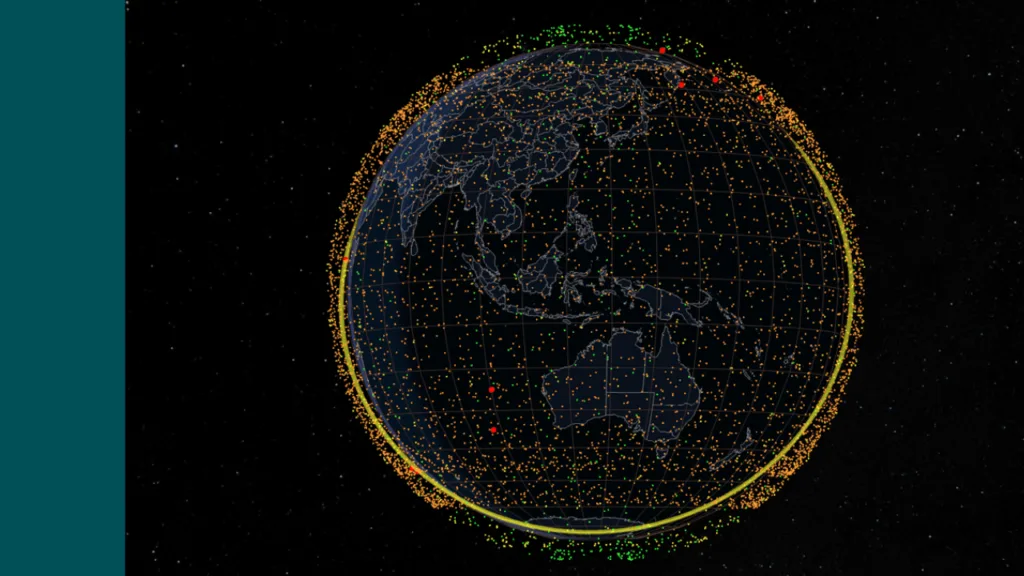
Live map of Satellites – 22 March 2026

Right now, swirling over our heads are more than 10,000 Starlink satellites, providing rocket-fast internet to approximately 10 million people. In satellites, SpaceX is THE company.
Its internet subscriber count has doubled each of the past two years, so despite being over 20 years old, it’s growing fast.
Many of these 10,000 satellites no longer reflect light, as I captured on my iPhone, since SpaceX got too many complaints from astronomers.
So they changed designs. But what’s really interesting is how fast it has grown. While there are over 10,200 Starlinks in space today, there was just 1 satellite in 2019.
SpaceX is not just “leading the space race”, it’s light-years ahead.
Perhaps all of the money that NASA “wasted” inspiring generations about Space and engineering since the 1950s is paying off for America?
For context, Amazon founder Jeff Bezos saw his rocket company, Blue Origin, land a rocket in November 2025. That was 10 years after Musk’s SpaceX landed its booster. In fact, some of SpaceX’s Falcon boosters have now been reused 529 times! The cost reduction for a rocket launch is down 65% as a result.
New Zealand-founded Rocket Lab (NASDAQ: RKLB), which specialises in smaller, but frequent, payloads, launched 21 rockets in 2025. That compares to SpaceX’s 170 flown missions in 2025 – accounting for about 52% of all orbital launches.
In other words, SpaceX is the gorilla of space.
You may remember, a couple of years back, we spoke to Swinburne University’s Professor Alan Duffy about the space economy. Back then, he noted it could be worth around $1 trillion.
It all sounds pretty good, right?
Not so fast, says one Raskal…
“I have S&P and other ETFs as part of my portfolio. I am very concerned about the potential IPO of SpaceX/ and how that will influence S&P and Nasdaq ETFs as they will be forced to buy in. I think that this IPO is [a] scam and will enrich the existing owners as they divest, and leave the public carrying [the] bag. Other than moving to ETFs that are less likely to include this IPO is there any other way I can reduce the influence of this IPO in my portfolio?” – Cuddly Koala, via the ‘‘ page.
I’m a space nerd.
Not many men sleep with a 12-inch within touching distance. But I do.
Seriously though, what triggered today’s email was this question (above), from Cuddly Koala.
It’s actually two (good) questions in one:
1) What the bloody hell is SpaceX, and why does it matter?
2) ETFs and index funds are ruining the stock market, so what can we do about it?
Let’s tackle them one by one.
What the bloody hell is SpaceX, and why does it matter?
See above.
SpaceX is the world’s most advanced rocket company. When PayPal was sold to eBay in 2002, Elon Musk took his $180 million and:
a) Invested $70-80 million into Tesla.
b) Put $20 million into SolarCity.
b) Invested everything else into starting SpaceX.
(Side note: Elon invested so much of his PayPal fortune into these three companies that, rumours say, he had to borrow money to pay rent.)
Fast forward a few years (24 years, to be precise) and Musk is potentially taking SpaceX public in 2026.
“Going public”, otherwise known as an “Initial Public Offering (IPO)”, is the process of turning a privately owned company into a publicly owned company, which allows any ol’ investor to buy shares via the stock market.
Information on SpaceX’s potential IPO is scarce.
Official documentation hasn’t been lodged.
However, rumours are growing…
Now, even Morningstar – one of the most trusted financial research organisations – is crunching numbers. It suggests SpaceX is already generating $16 billion of revenue at a 47% margin (making $7.5 billion of operating profit) and says it’s readying for an IPO.
SpaceX’s revenue primarily comes from Starlink, which is the monthly satellite internet service that will soon connect directly to mobile phones (currently, you are required to purchase a small satellite dish to connect).
Morningstar are not pulling punches on SpaceX’s potential.
The research house thinks SpaceX could generate $150 billion of revenue and a profit of nearly $100 billion per year, by 2040. By contrast, Microsoft made a similar amount of profit last year.
And if it lists on the stock exchange, SpaceX is officially the only company – ever – that we could literally say, “it’s a moonshot”.
Why?
SpaceX has a solid and growing internet business in Starlink, plus world-leading rocket capabilities, plus ‘top 5’ AI capabilities via its ownership of Grok and xAI.
However, SpaceX also has two speculative goals: building a base on the moon (codenamed Moonbase Alpha) and deploying AI data centres in space via 1 million interconnected satellites.
The second one is much easier than the first.
The concept of ‘space internet’ is now proven, so it’s a numbers game: AI computing in space requires ‘only’ 6,667 Starship launches every year to deploy the target amount. Yes, it’s an extreme goal. And yes, Starship (the world’s biggest rocket – by a long way), is only just through testing.
But the economic incentive is there: energy usage can make up more than 50% of the costs of providing AI services on earth (think: ChatGPT, Claude, Gemini, etc.). There is no water usage, rust, wear and tear, or even greenhouse gas to worry about in space.
And remember, if people are willing to pay for a service like that, it implies the service creates more value for society than it captures. This is the essential recipe of capitalism. A giant demand curve (like AI) makes massive supply challenges (6,000+ rockets going to space each year) a commercial reality.
Again, they are moonshot ideas. Even still, the chorus of investors saying the SpaceX rockets and satellite internet business is “enough to justify a $1.5 trillion valuation” is growing. I’d like to see more fundamental data before making that call.
Dumb ETFs
I think it’s fair to say that index funds and ETFs are beginning to mess with the stock market. And things will only get weirder from here.
Breadcrumbs have already appeared.
In Australia, companies like Guzmen y Gomez (ASX: GYG) and Chemist Warehouse / Sigma Healthcare Ltd (ASX: SIG) IPO’d in recent years.
In my opinion, their investment bankers have taken advantage of “dumb index funds and ETFs”. How?
Index funds and ETFs are required to buy shares in every company added to the index they track (e.g. the ASX 200 or ASX 300).
In simple terms, when a big company first hits the stock market, the limited number of shares up for grabs is held tight – but the index funds and ETFs are required to buy some. So it can create a distortion in the market: shares go up for no genuine reason.
It’s just automated buying from hundreds of thousands of Australians, pension funds and foreign investors piling into index funds and ETFs.
The hallmarks of an “ETF-pumping IPO” are:
1. The IPO is big enough to fit into the largest index (e.g. ASX 200 in Australia, NASDAQ 100 in the USA, etc.).
2. Only a tiny number of shares are released to the public.
3. Insiders promise not to sell out… immediately.
4. The stock brokers – in Australia, that’s names like Bell Potter, Morgans, Goldman Sachs, Morgan Stanley, etc. – salivate over ‘access’. These “wealth advisers” then flog an ‘exciting opportunity’ to their rich but financially illiterate clients.
In the case of SpaceX, just 3% of shares are due to be floated to investors. That’s enough to generate as much as $US50 billion of cash for SpaceX to fund growth. Or, if I’m being skeptical (sceptical?), like Cuddly Koala, it’s enough to pump the stock price to the moon, as part of a hyped-up retail investor and ETF buying frenzy.
Is this market behaviour the ‘right’ thing for the stock market?
It’s probably not right. But the public stock market is already so heavily regulated and costly for companies to use; adding new rules will just make it worse. This is why the total number of companies available on the stock market is falling rapidly. We’ve aired this concern numerous times since 2020, both here and in Rask podcasts.
Is an ETF-pumping IPO a new idea?
Not really. On Rask podcasts, for years we’ve been talking about ETFs distorting the stock market. As always, there’s no replacement for a bit of HI (Human Intelligence) when the finance world gets creative.
If you’re buying stocks yourself, you need to know which companies are telling you porkies and which aren’t. You must read all of the fine print in IPO docs and broker reports. And remember, in an IPO you’re always buying from someone who knows more than you do (an insider, or their banker).
Is there anything we can do about ‘dumb ETFs’?
No. We cannot change the fact that Vanguard’s VAS ETF will invest millions in shares of CBA this month – even if CBA is overvalued. iShares IVV will buy bucketloads of SpaceX if it IPOs.
These ETFs are designed like this for a reason.
However, you can control which shares, ETFs, trusts, LICs, REITs, property and crypto go into your portfolio. So, as always, don’t put all of your eggs in one basket.
You should know that we still own – and like – IVV and VAS. We hold them inside Rask Invest.
SpaceX: Buy, Hold or Sell
If SpaceX completes an IPO at a $1.5 trillion valuation, it’ll be just 3.5% of the Betashares NASDAQ 100 ETF (ASX: NDQ), based on today’s weightings. I wouldn’t be prepared to sell the other 96% of my NASDAQ ETF just to remove the 4% I don’t like.
For investors looking for a slice of SpaceX today, you should know it’s not easy to buy shares of SpaceX. It’s still a private company.
A few established holding companies and corporates own some of it, like Alphabet (owner of Google), which invested $1 billion into SpaceX many moons ago; or even Pengana’s Private Equity Trust (ASX: PE1) – which is an ASX-listed trust that owns shares of global private companies, like SpaceX.
In either case, we can’t make a full and proper assessment of the SpaceX business model and industry until we can read the SpaceX Prospectus (called an ‘S1’ in the USA). At the end of the day, it all comes down to fundamentals.
While the valuation could be as high as 95x yearly revenue, if the company can keep buying more mobile spectrum (used to convert satellite >> mobile reception) and sign up tens, or even hundreds, of millions of internet subscribers each year, plus keep winning government and corporate satellite launch contracts… the potential is enormous. And unlike your local $1 trillion startup, this business has already proven itself.
I could be wrong, but rumours suggest we might start hearing more about SpaceX’s IPO in May/June 2026. It’ll be the biggest IPO in history if it goes ahead, and potentially the most fascinating company you’ll read about in your lifetime.
I’ll keep you posted here, every Sunday, as more information emerges.
~~~
In the meantime, I know it’s been a tough month for many investors, retirees and business owners. So I hope you’re reading this week’s email in a state of equanimity, as Charlie Munger would say.
I know many of us believe the worst of inflation looks certain to come, which is bad news.
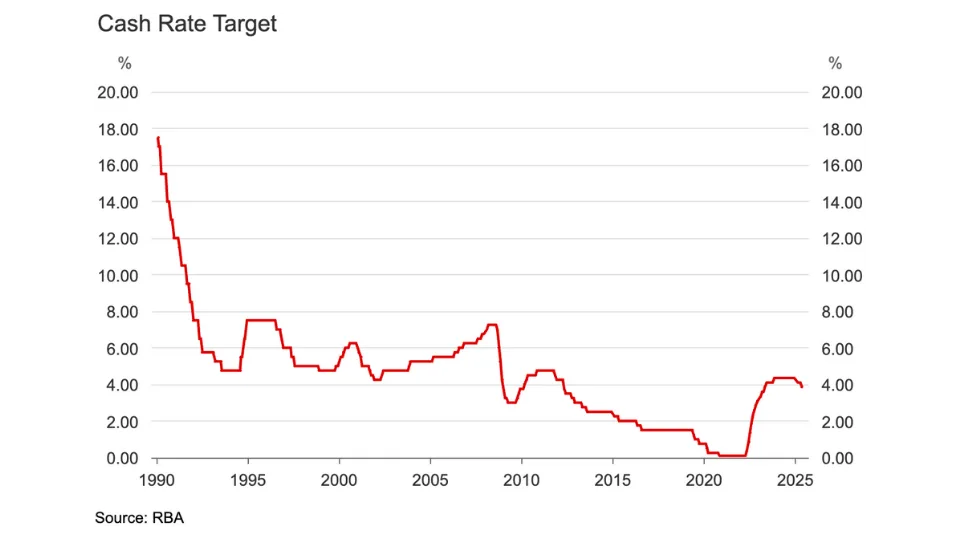
And whether or not the RBA keeps lifting interest rates, our Government seems hellbent on giving us extra pocket money… to “combat” the effects of high fuel prices 🙃 (Yes, it’s as dumb as it sounds.)
Nonetheless, I hope you’re happy and prepared for whatever comes next.
If you want to invest more confidently, or just get back to doing other things with your life, consider getting the Rask team and me on your side with Rask Invest. We can invest for you.
Here is a list of our core strategies:
As you can see, I definitely wasn’t joking about that 12-inch Dobsonian…
Until next Sunday,
Chief Investment Officer, Rask Invest
Founder, Rask
P.S. I’m going heavy on a tiny disclosure: PE1 is a ‘trust’ run by Pengana. Pengana owns TermPlus – the advertiser for this weekend’s email (see below). I wasn’t paid to mention Pengana. So, unless Pengana was inside my brain at 11 pm on Saturday night, they had no idea I was going to write about SpaceX or PE1 today. I don’t own shares of PE1 but as Mitch and Drew reminded us yesterday it may be worthy of more research!
P.P.S. Elon Musk owns 42% of SpaceX – so right now his estimated net worth is… $US823 billion ($1.17 trillion). As the kids say, “LOL”.